
The stain on the couch. The cracked countertop. The dent in the dryer door that definitely wasn't there before the last guest. You know the damage happened during a specific stay. But can you prove it?
For most STR hosts, the answer is "sort of." They have some photos somewhere in their camera roll, mixed in with pictures of their lunch and screenshots of memes. They remember roughly when it happened. They think it was the guests from two weekends ago, but it might have been three.
This is how hosts lose damage disputes. Not because the damage didn't happen, but because the documentation doesn't hold up.
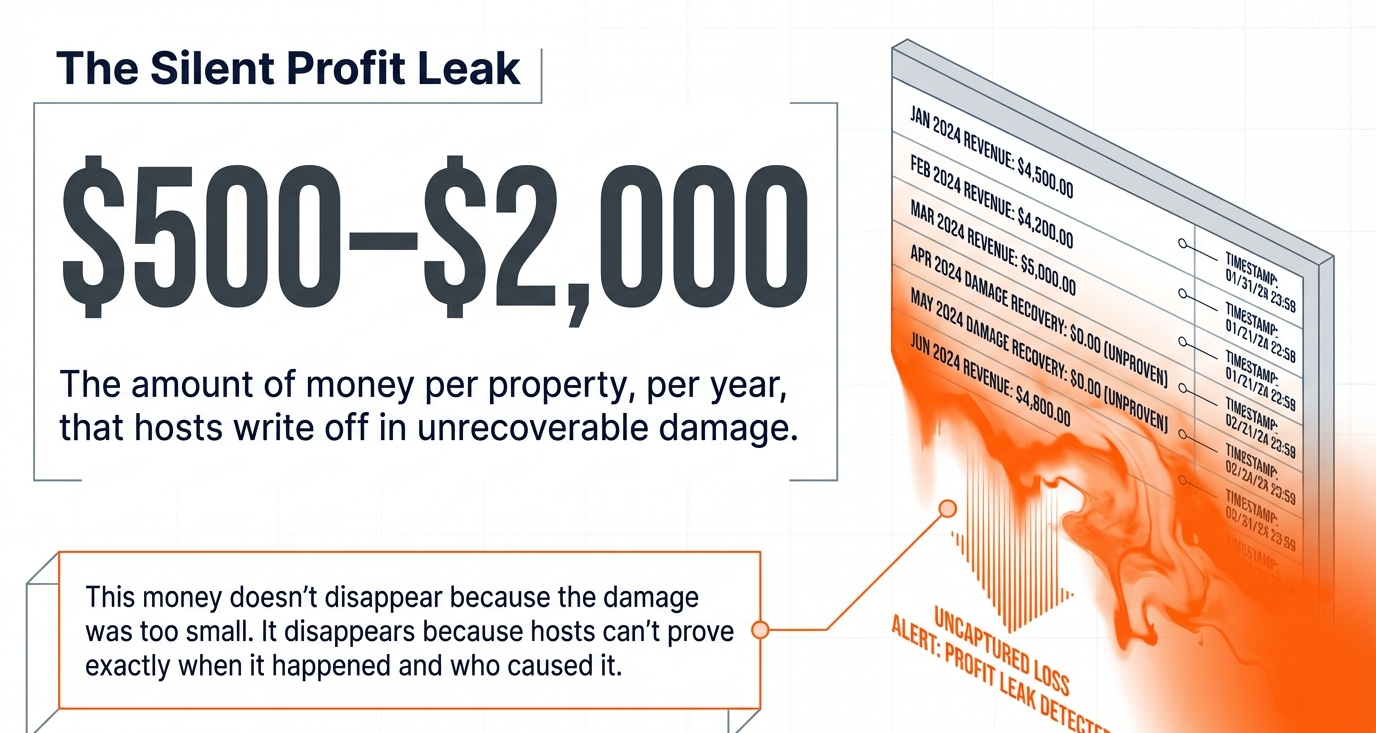 This money doesn't disappear because the damage was too small. It disappears because hosts can't prove exactly when it happened and who caused it.
Why documentation wins (and why "I know it happened" loses)
Airbnb's resolution center, VRBO's damage claims process, and homeowner's insurance all have one thing in common: they require evidence. Not your word — evidence. Timestamped photos, repair estimates, a clear timeline showing the property's condition before and after the stay in question.
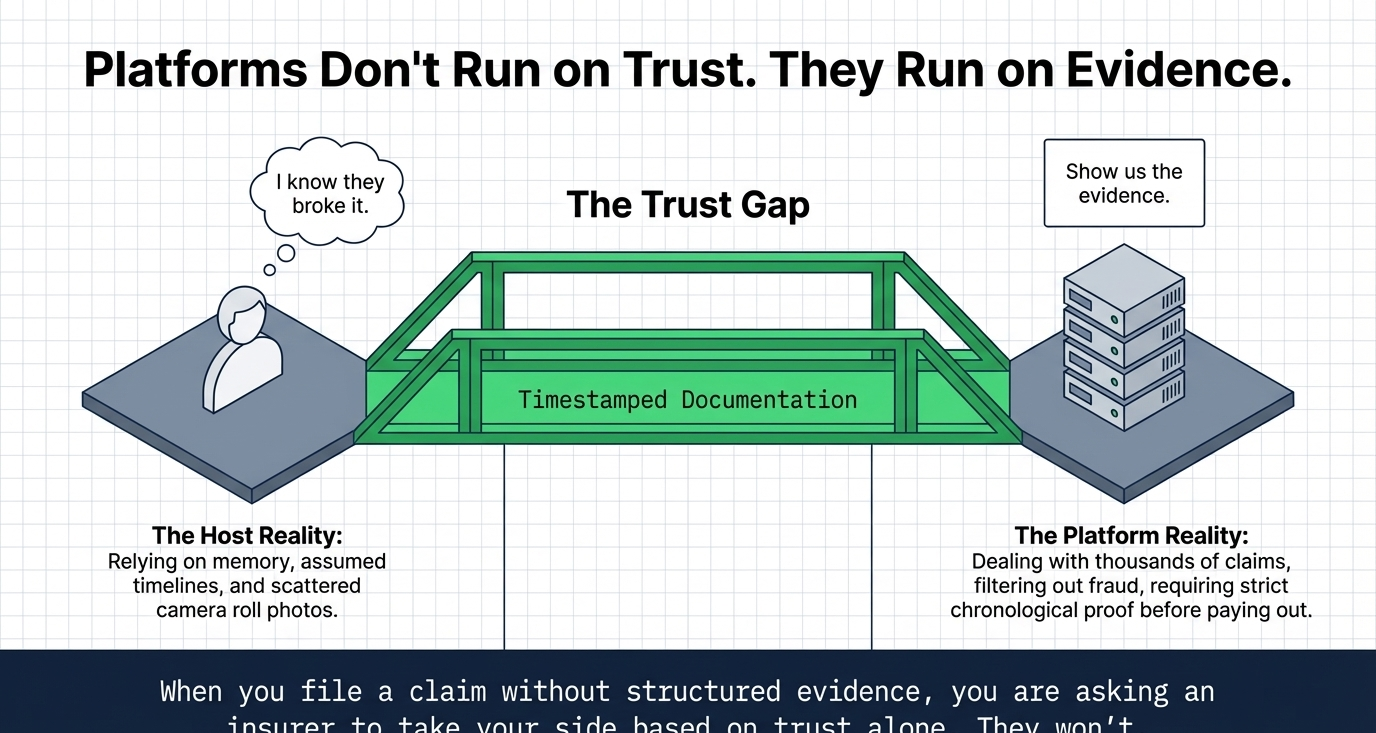 When you file a claim without structured evidence, you are asking an insurer to take your side based on trust alone. They won't.
When you file a claim without that evidence, you're asking the platform or insurer to take your side based on trust. They won't. They deal with thousands of claims, and a significant percentage are exaggerated or fraudulent. The only way to distinguish a legitimate claim from a questionable one is documentation.
The hosts who win disputes consistently aren't luckier. They have a system that produces the evidence they need, automatically, every time.
What to capture when damage occurs
When you discover damage, the clock starts. Platforms like Airbnb impose strict deadlines for damage claims — often 14 days or before the next guest checks in, whichever is sooner. Insurance companies want prompt reporting. Every day between discovery and documentation weakens your position.
Here's what to capture immediately:
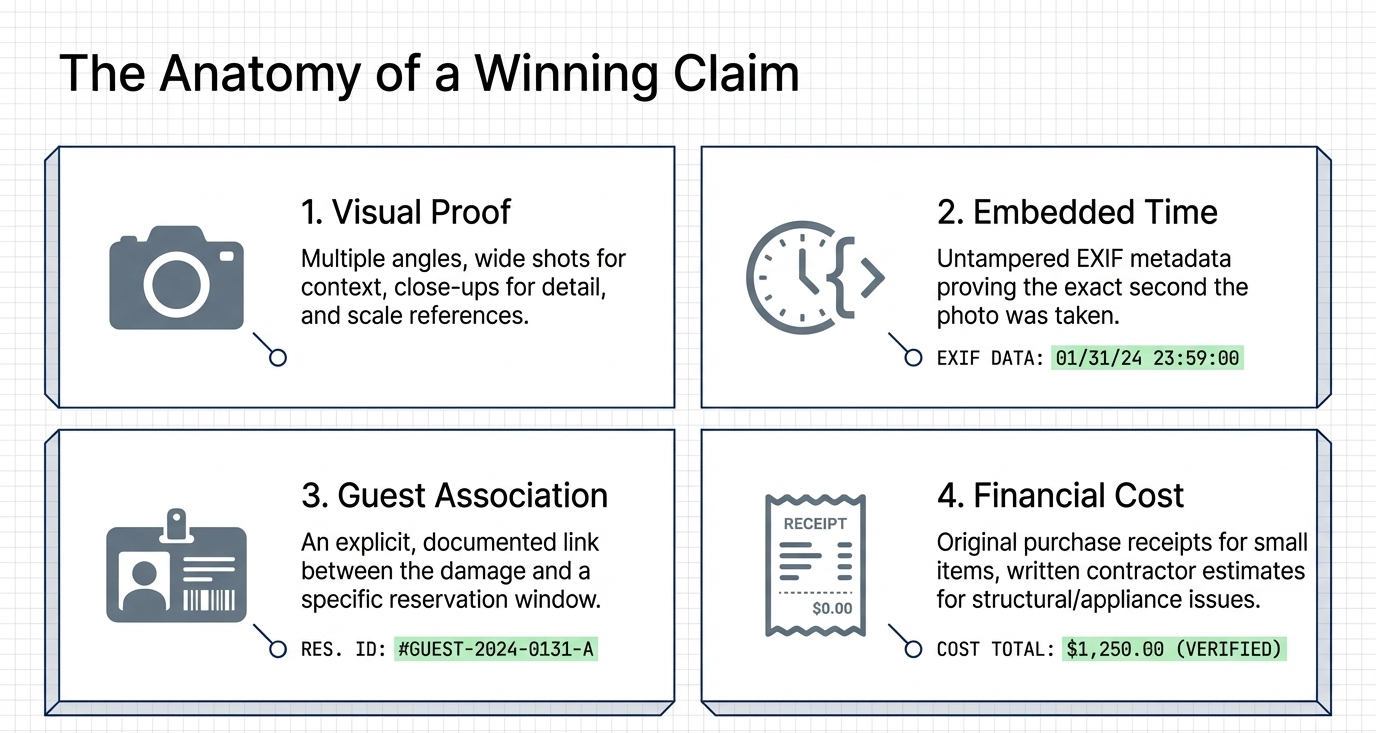 Every winning claim has the same four components. Missing any one of them weakens your position.
Photos and video
Take photos from multiple angles. Get a wide shot showing the location within the room and close-ups showing the damage detail. If it's a stain, include something for scale. If it's a broken item, photograph the broken pieces.
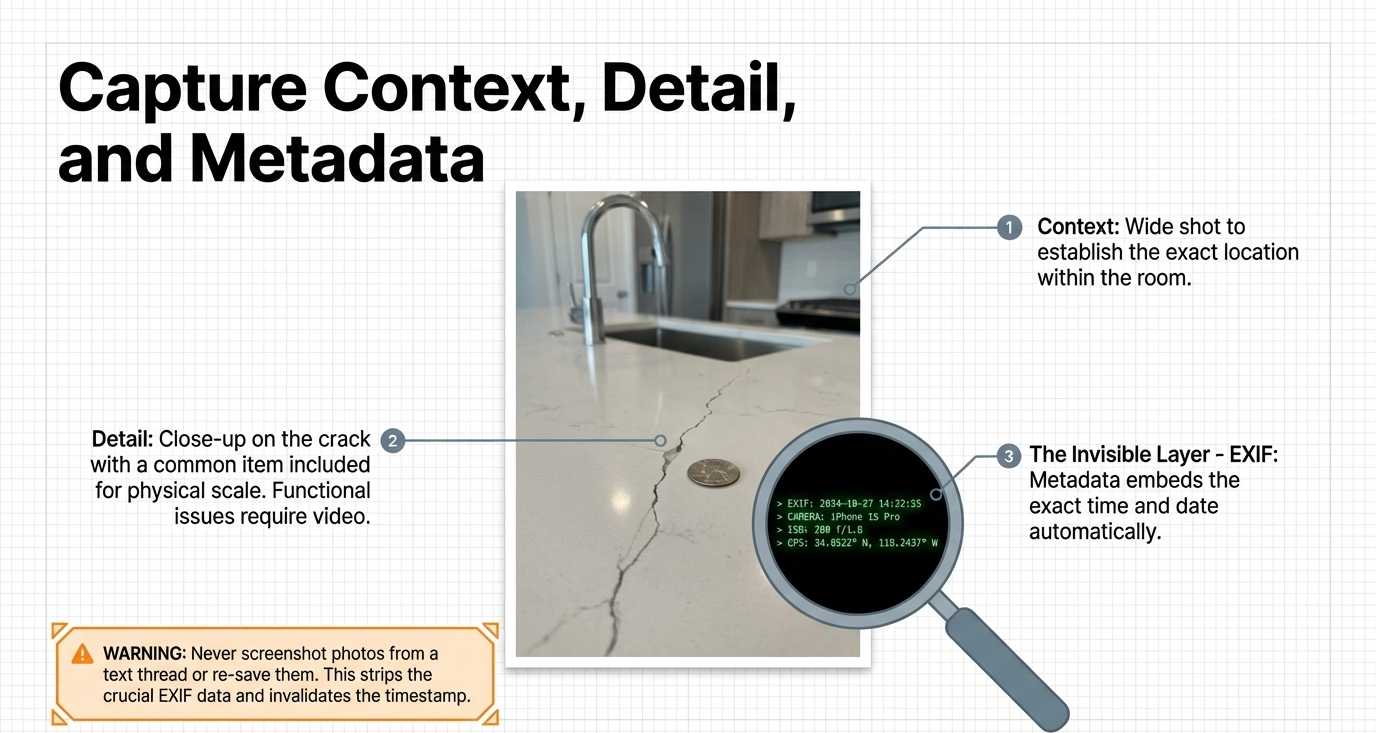 Never screenshot photos from a text thread or re-save them. This strips the crucial EXIF data and invalidates the timestamp.
Video is even better for damage that's hard to convey in a still image — a door that won't close properly, a faucet that leaks, a window with a hairline crack.
Timestamps
Every photo needs a timestamp. Not one you write on a sticky note — one embedded in the file metadata. This is where phone camera rolls actually work in your favor, since every photo is automatically timestamped. But you need to preserve that metadata, which means not screenshotting photos from a text thread or re-saving them in a way that strips the EXIF data.
Guest association
This is the piece most hosts miss. You know which guest caused the damage, but your claim needs to make that connection explicit. Document: the guest's name, their reservation dates, the date the damage was discovered (ideally the same day they checked out), and the condition of the property before their arrival.
Cost documentation
Get a repair estimate or replacement cost. For common items (linens, glassware, small furniture), you can reference the original purchase price and receipts. For structural damage or appliance issues, get a written estimate from a contractor or repair service.
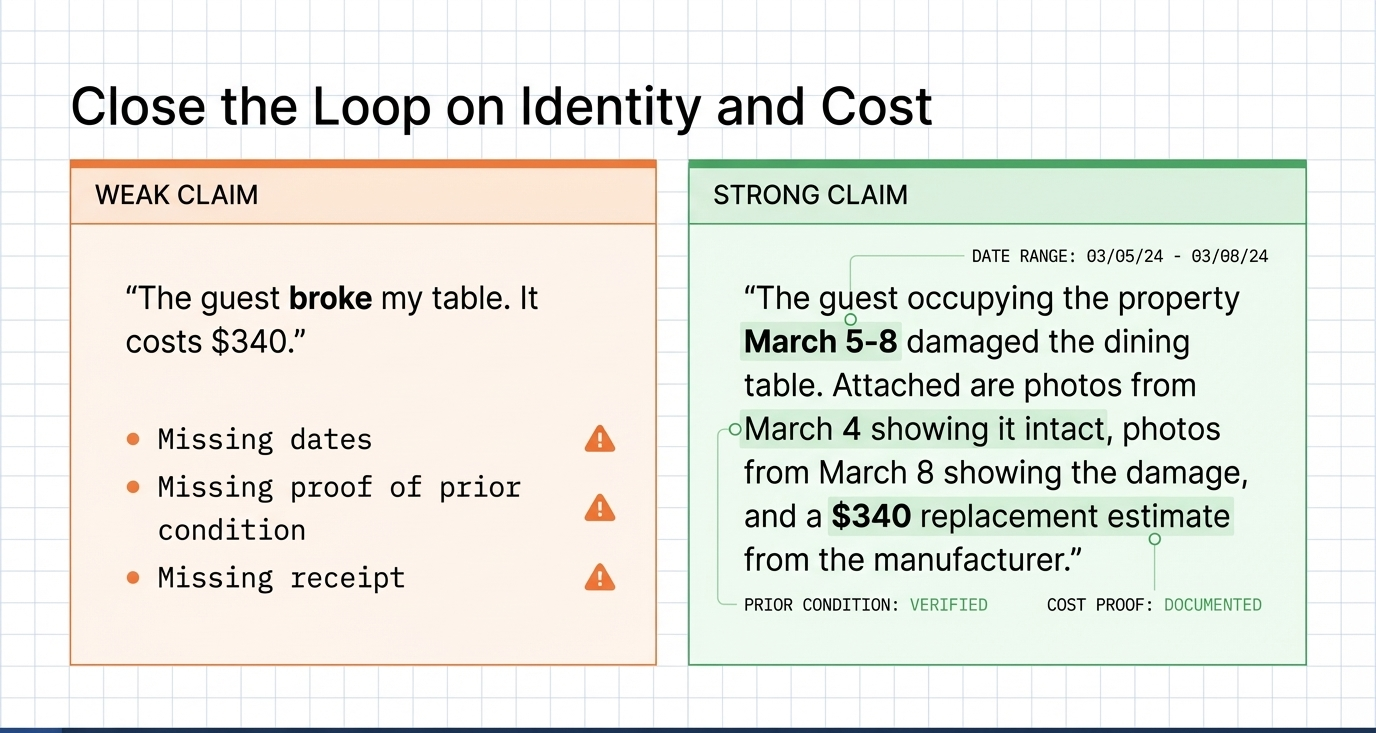 The clock is ticking. Platforms impose strict deadlines — often 14 days after checkout, or before the next guest arrives, whichever is sooner.
A vague claim of "the guest broke my table" is weak. A claim that says "the guest during March 5-8 damaged the dining table, here are photos from March 4 showing it intact and March 8 showing the damage, and here's a $340 replacement estimate from the manufacturer" is strong.
The power of pre-stay and post-stay photos
The single most effective thing you can do for damage documentation is establish a baseline. Take a standard set of photos before every guest arrives and after every guest leaves. Not a full professional shoot — a quick walkthrough covering:
- Kitchen — countertops, appliances, cabinets
- Bathrooms — fixtures, mirrors, vanity
- Living areas — furniture, walls, floors
- Bedrooms — bed frame, nightstands, closet doors
- Outdoor spaces — patio furniture, grill, fencing
- High-value items — electronics, artwork, specialty fixtures
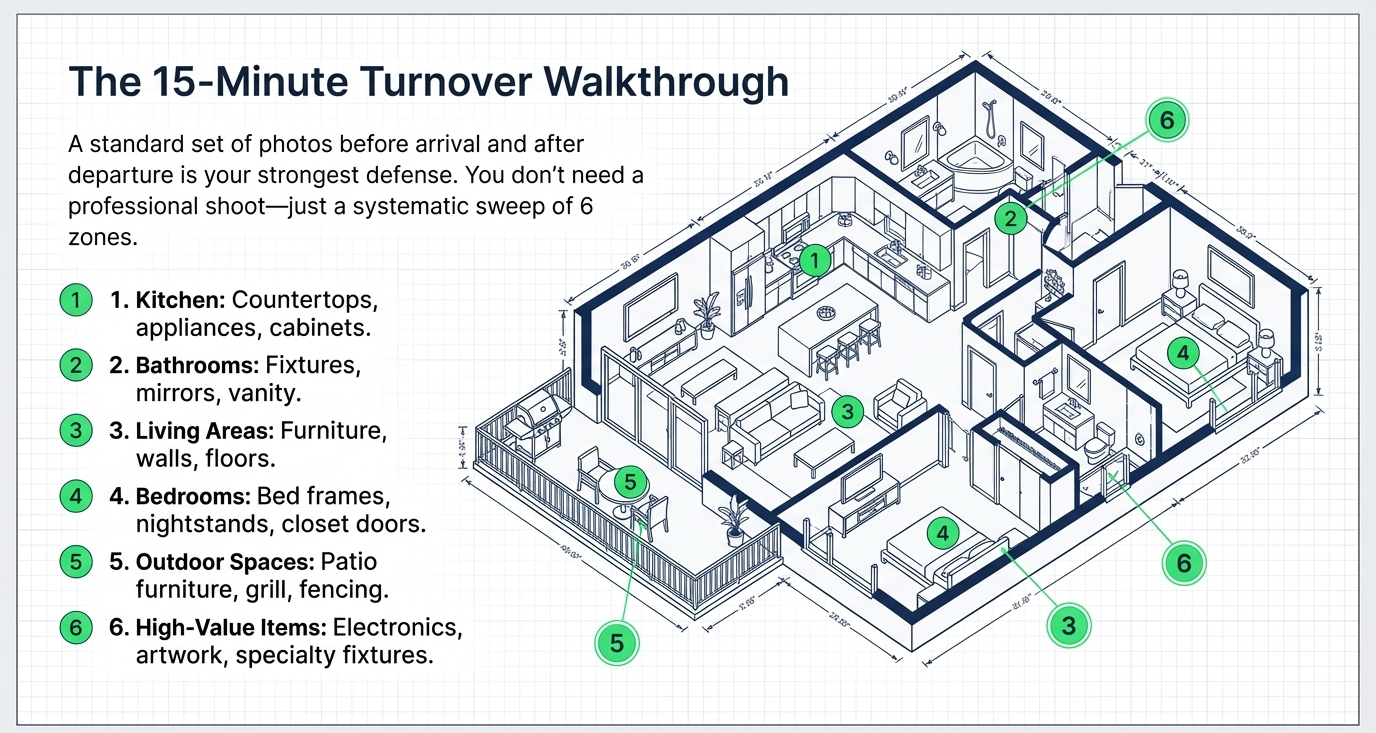 You don't need a professional shoot — just a systematic sweep of 6 zones. This is your strongest defense.
This takes 10-15 minutes per turnover. It feels tedious. It's also the difference between winning and losing a $500 claim.
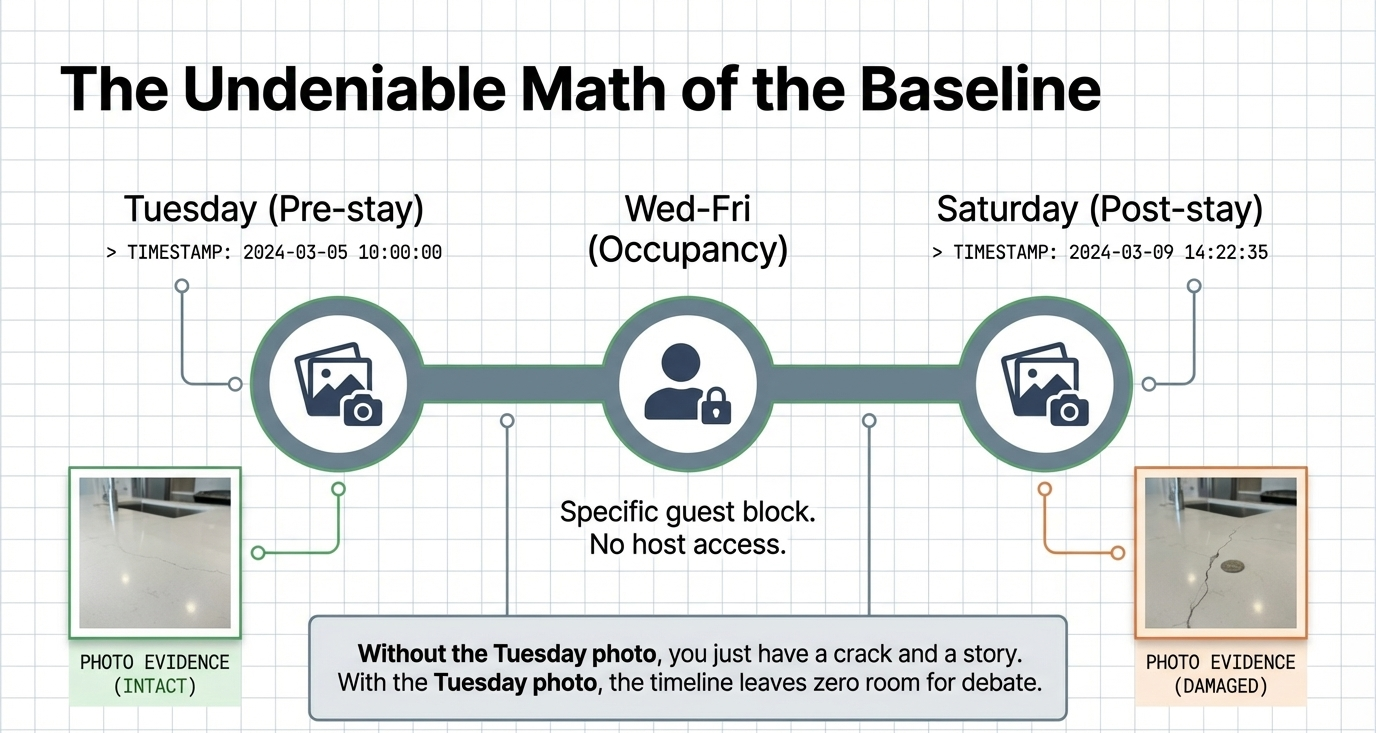 Without the Tuesday photo, you just have a crack and a story. With the Tuesday photo, the timeline leaves zero room for debate.
When you have a photo from Tuesday showing an intact countertop and a photo from Saturday showing a crack in the same countertop, with a guest occupying the property from Wednesday through Friday, your timeline is airtight. Without the Tuesday photo, you have a crack and a story.
Why your camera roll isn't a system
Most hosts start by taking damage photos on their phone. That works for the first incident. By the tenth, you have damage photos scattered across months of camera roll, unlabeled, with no connection to the guest or property they belong to.
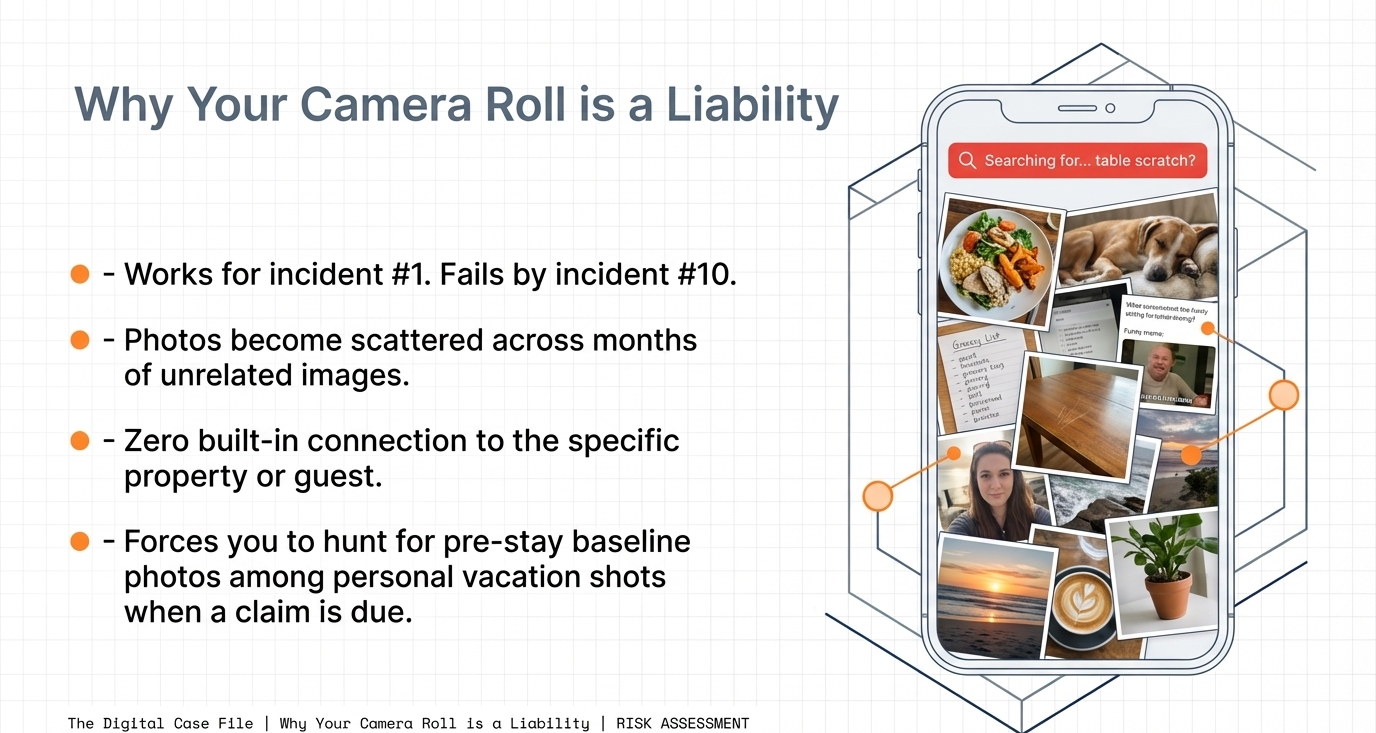 Works for incident #1. Fails by incident #10.
When you need to file a claim, you're scrolling through hundreds of photos trying to find the right ones. When you need to prove the pre-stay condition, you're hoping you remembered to take photos that particular week and can locate them among vacation shots and grocery lists.
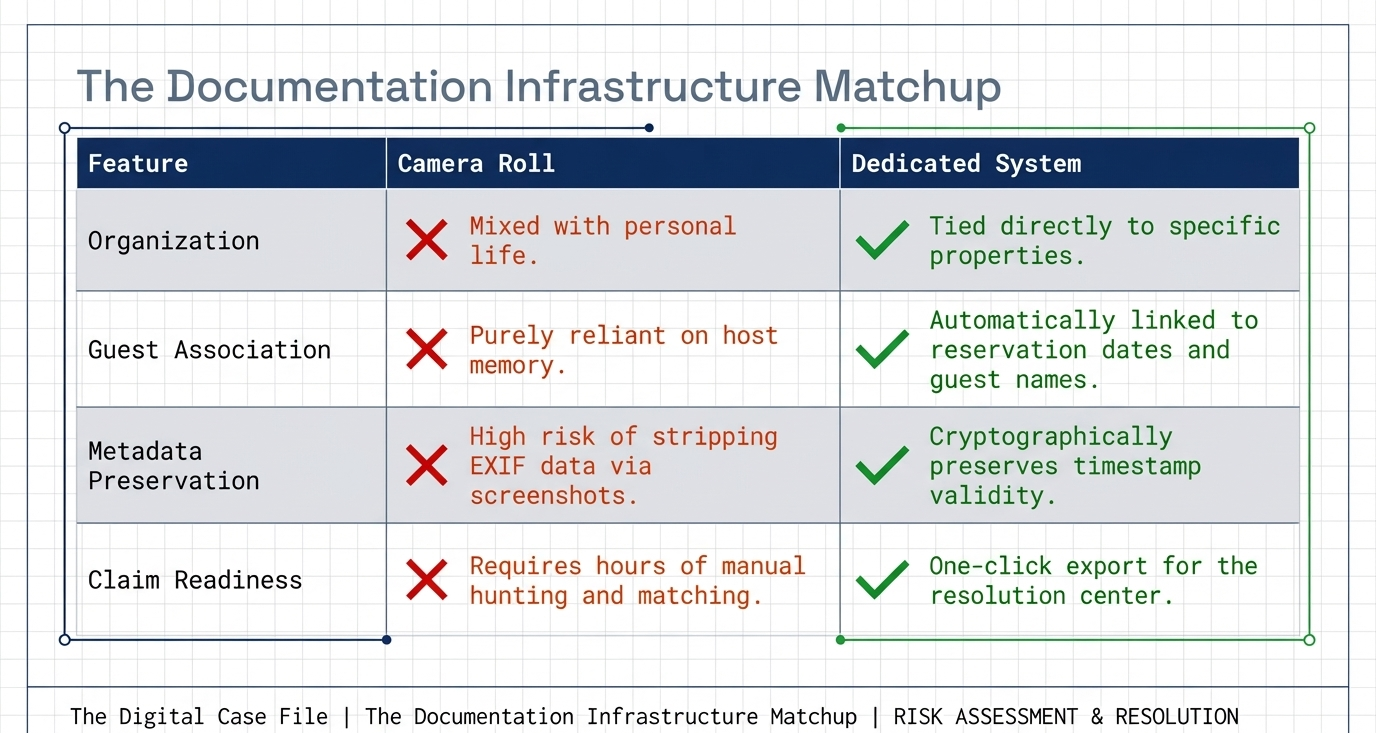 The structural comparison makes the gap clear on every dimension that matters for claims.
A dedicated system — even a structured folder on your computer — beats the camera roll approach. But what works better is a tool that ties photos to properties, guests, and dates automatically. ArrivHQ's damage logging lets you create an incident with photos, estimated cost, and guest association in one place. Every incident is timestamped, tied to a property and reservation, and exportable when you need to file a claim.
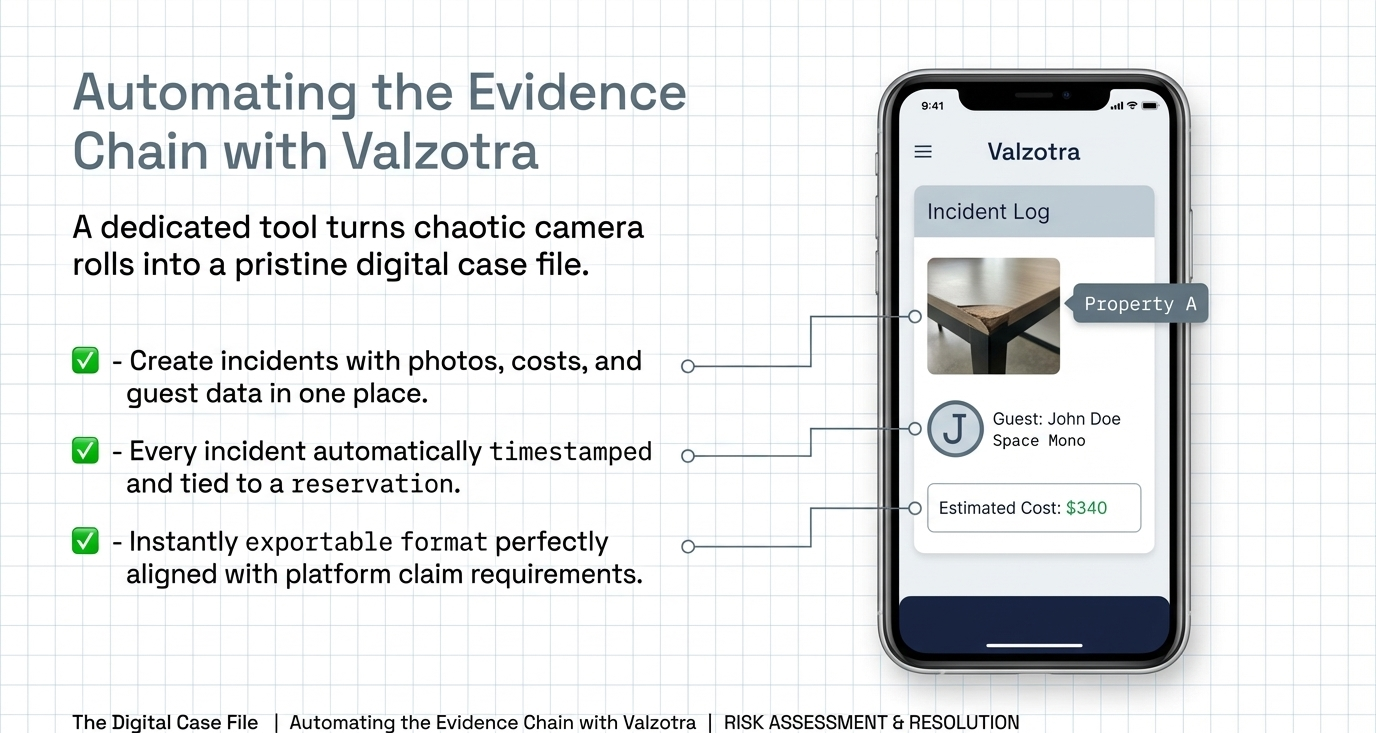 A dedicated tool turns chaotic camera rolls into a pristine digital case file.
Building the habit
Damage documentation only works if it's habitual. A system you use for the big incidents but skip for the small ones will eventually fail you on a medium-sized claim that matters.
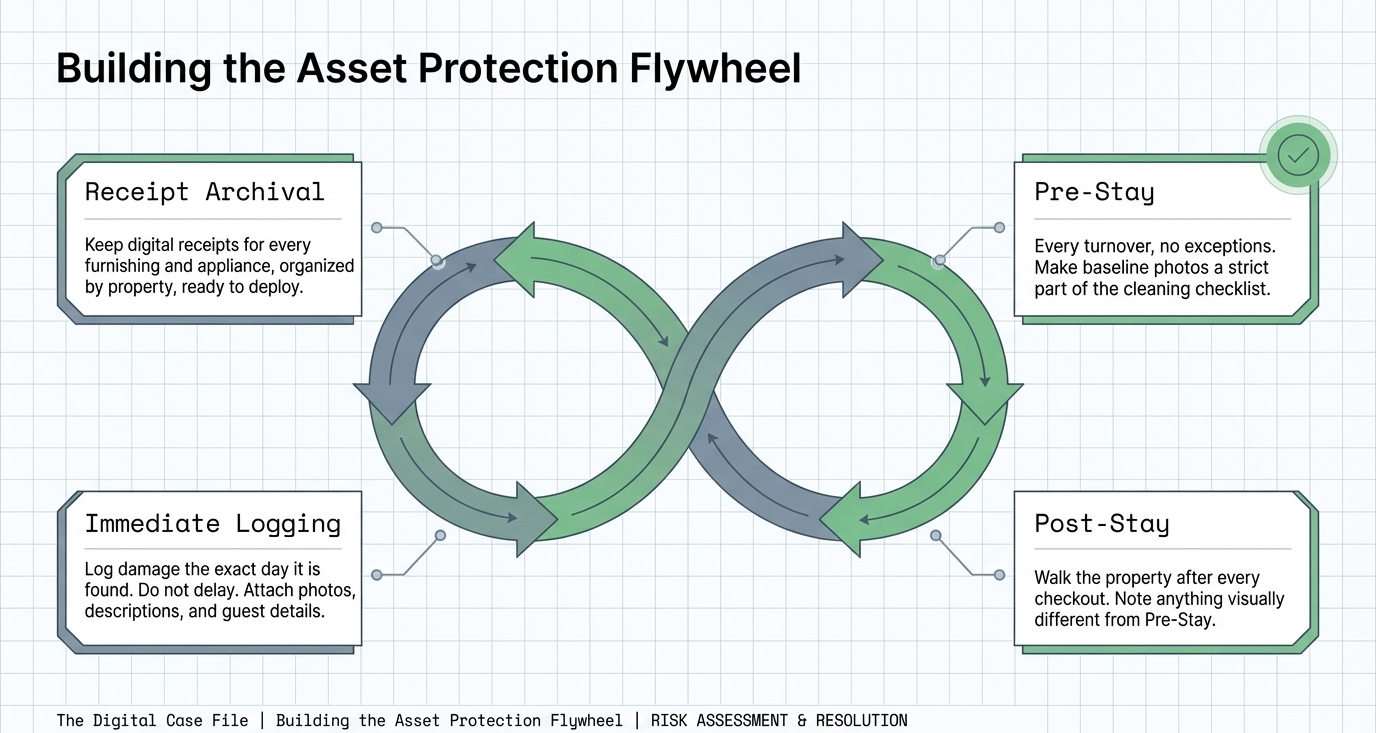 Four habits that form a continuous protection cycle. Skip any one and the flywheel breaks.
The approach that works:
- Pre-stay photos — every turnover, no exceptions. Make it part of the cleaning checklist.
- Post-stay inspection — walk the property after every checkout. Note anything that looks different.
- Immediate logging — if you find damage, log it that day. Photos, description, guest association, estimated cost. Don't tell yourself you'll do it later.
- Keep receipts — for every furnishing and appliance in the property. Store them digitally, organized by property.
This habit protects you not just for individual claims, but for the long-term pattern. If you ever face a dispute about normal wear and tear versus guest-caused damage, a complete photographic history of the property — organized by date and stay — is the strongest evidence you can have.
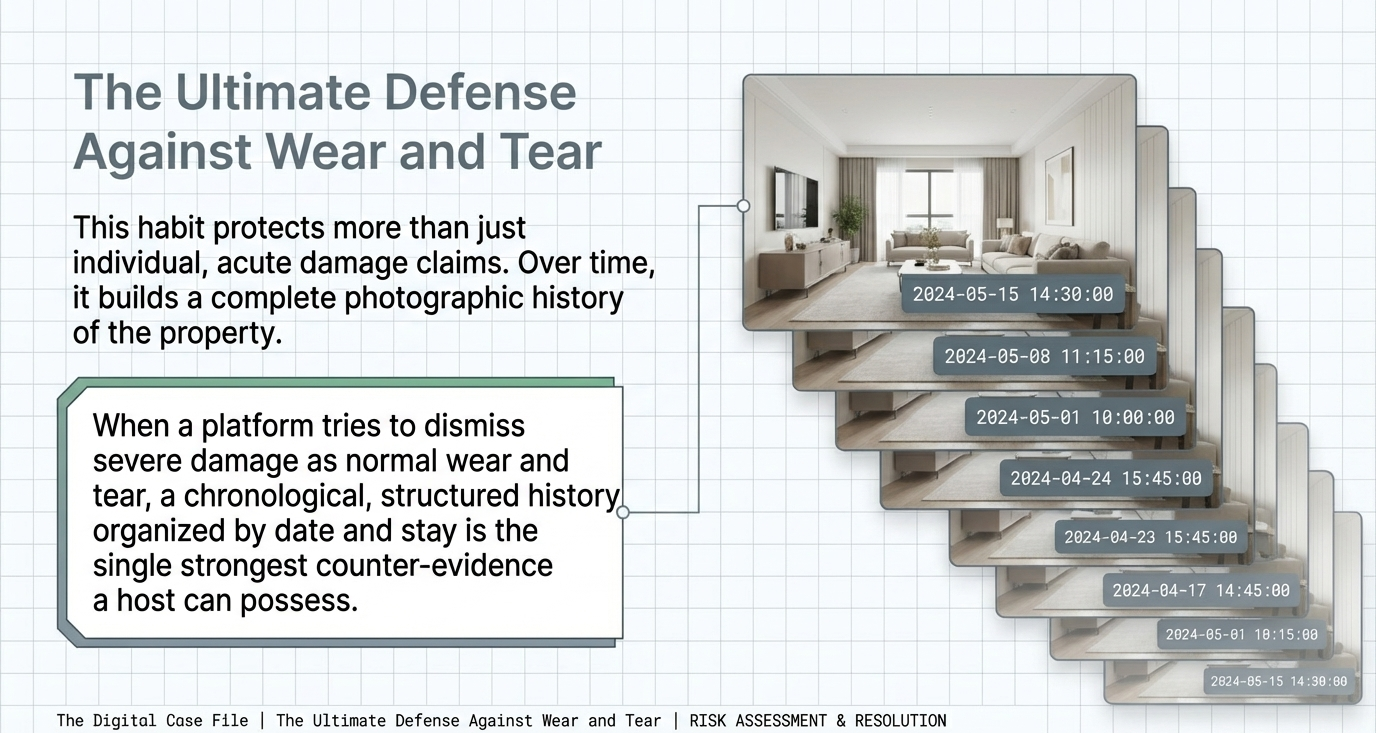 When a platform tries to dismiss severe damage as normal wear and tear, a chronological, structured history organized by date and stay is the single strongest counter-evidence a host can possess.
The cost of not documenting
Hosts who don't document damage consistently report writing off $500-$2,000 per property per year in unrecoverable damage. Not because the damage is too small to claim, but because they can't prove it happened when they say it did, caused by who they say caused it.
That's money directly off your bottom line. A 15-minute per-turnover documentation habit isn't overhead — it's insurance that actually pays out.
 Stop losing disputes to messy documentation.