
You get a booking confirmation and email the guest a welcome message. They reply with a question about parking. You answer. They ask about early check-in. You answer that too. Then they forward the thread to their travel partner who replies from a different email address asking the same parking question. Meanwhile, your co-host messages the guest separately about the wifi password, creating a parallel thread the guest now has to reconcile with yours.
This is how most STR hosts handle guest communication. And it's a mess.
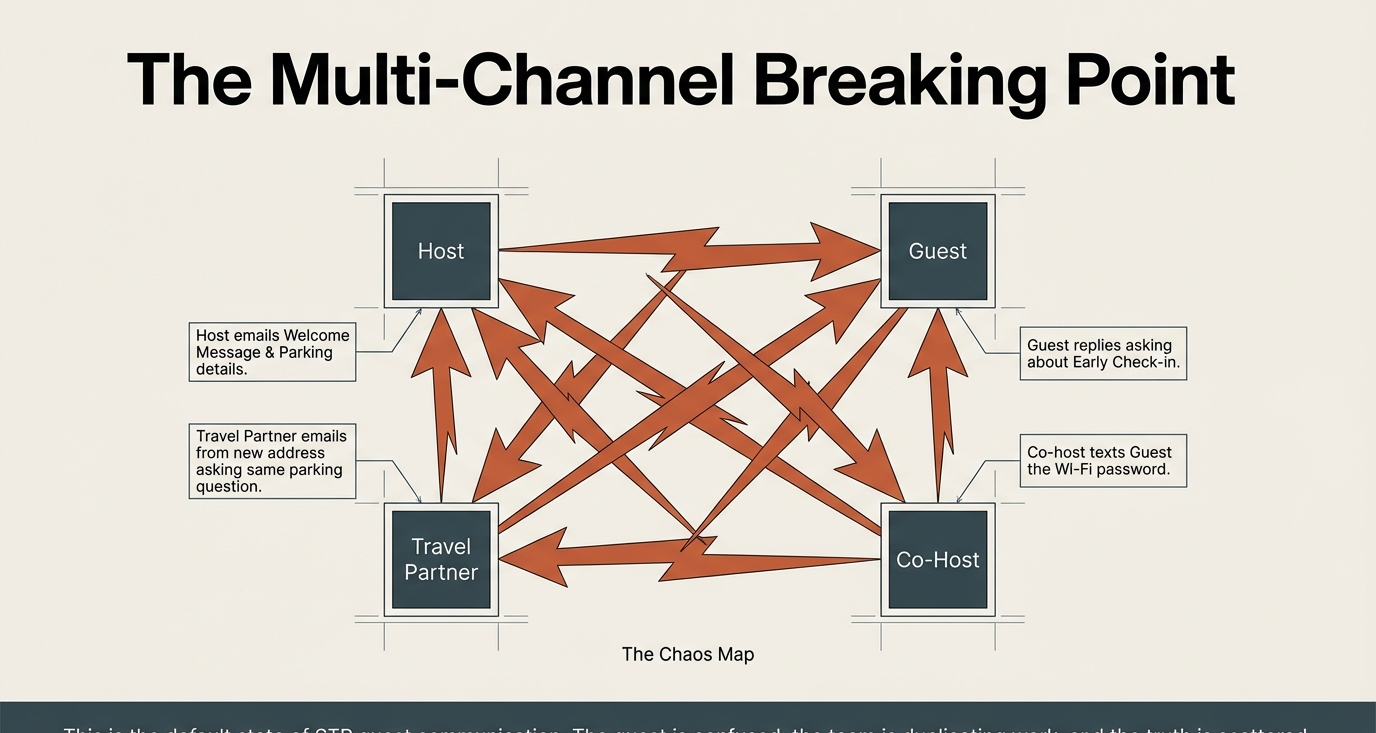 The guest is confused, the team is duplicating work, and the truth is scattered across inboxes.
The problem with email
Email was designed for asynchronous, one-to-one correspondence. It was not designed for managing operational communication across multiple properties, multiple guests, and multiple team members. Here's where it breaks down:
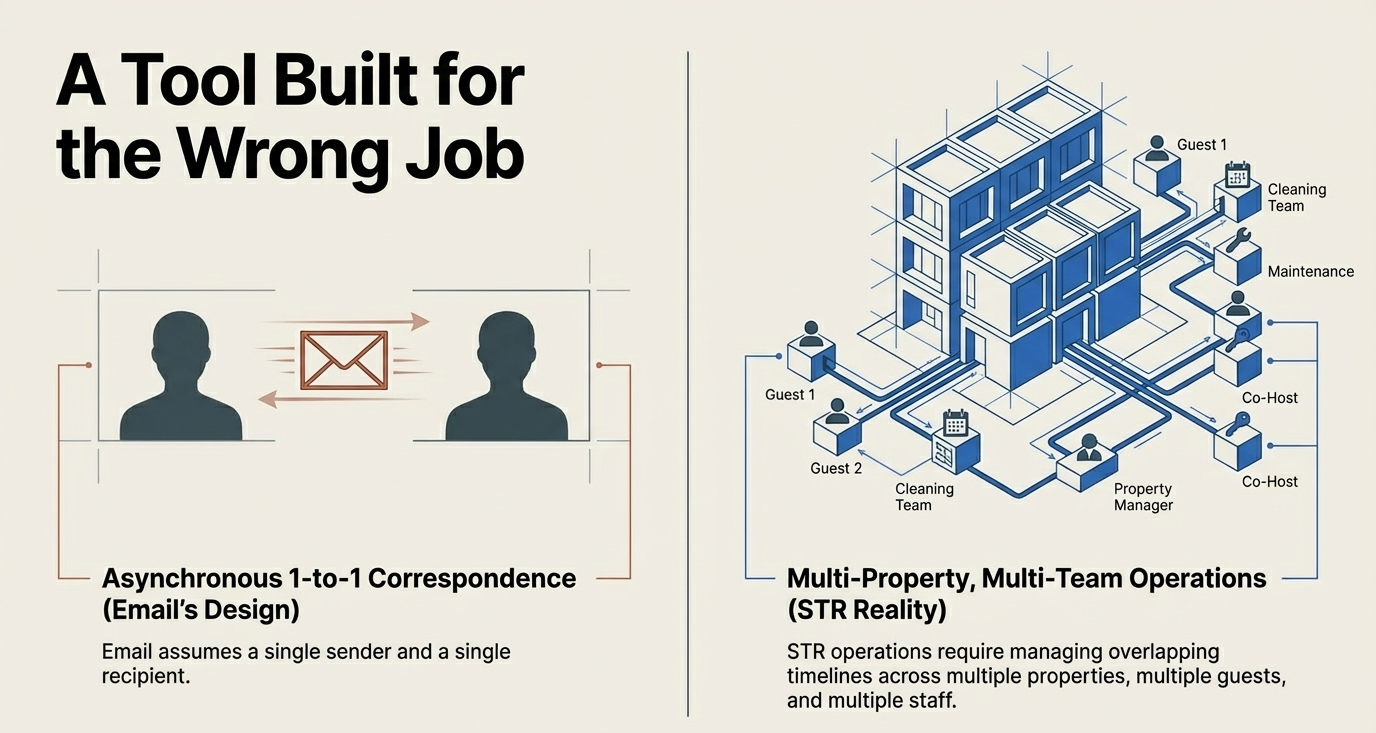 Email assumes a single sender and a single recipient. STR operations require something fundamentally different.
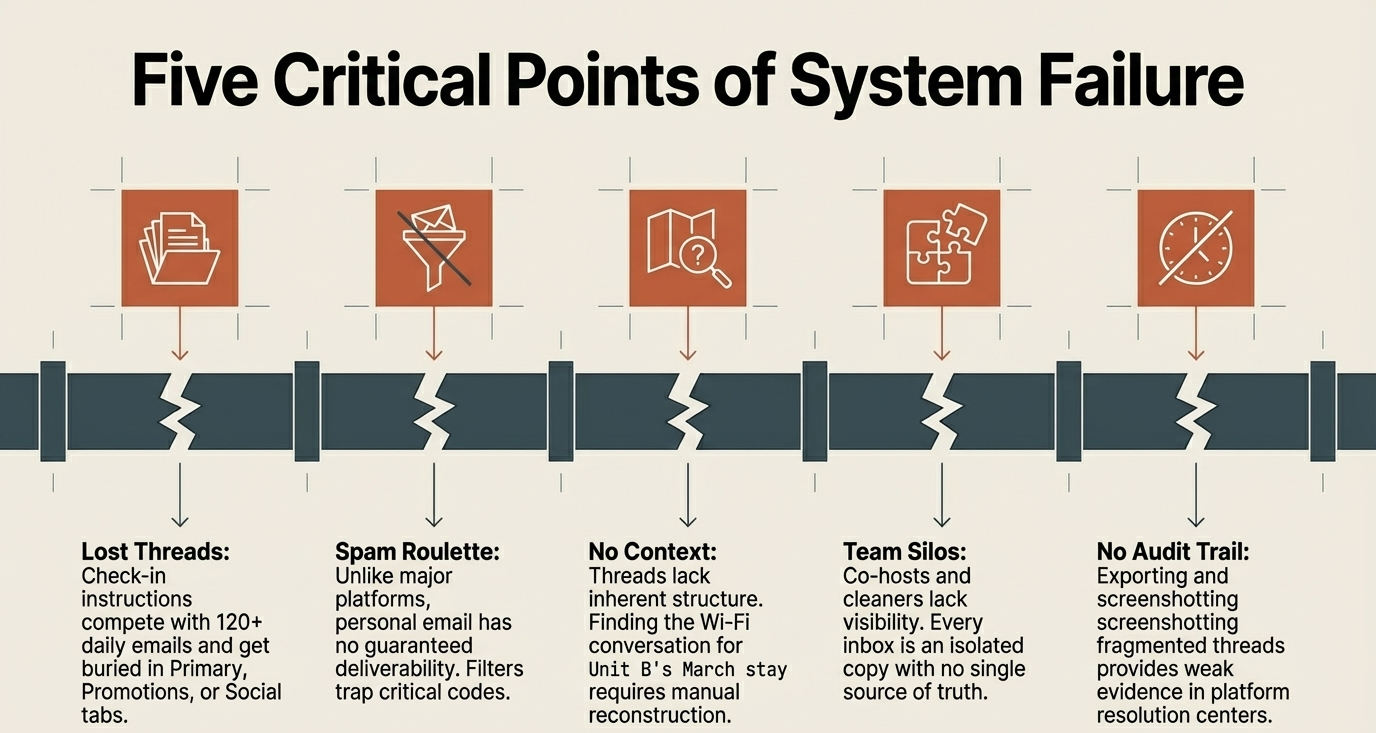 Email fails at five critical points — any one of them can cost you a review, a dispute, or a guest's trust.
Lost threads and buried messages
The average person receives 120+ emails per day. Your carefully crafted check-in instructions — the ones with the lockbox code, the parking details, and the wifi password — are competing with promotional emails, work correspondence, and subscription newsletters for your guest's attention.
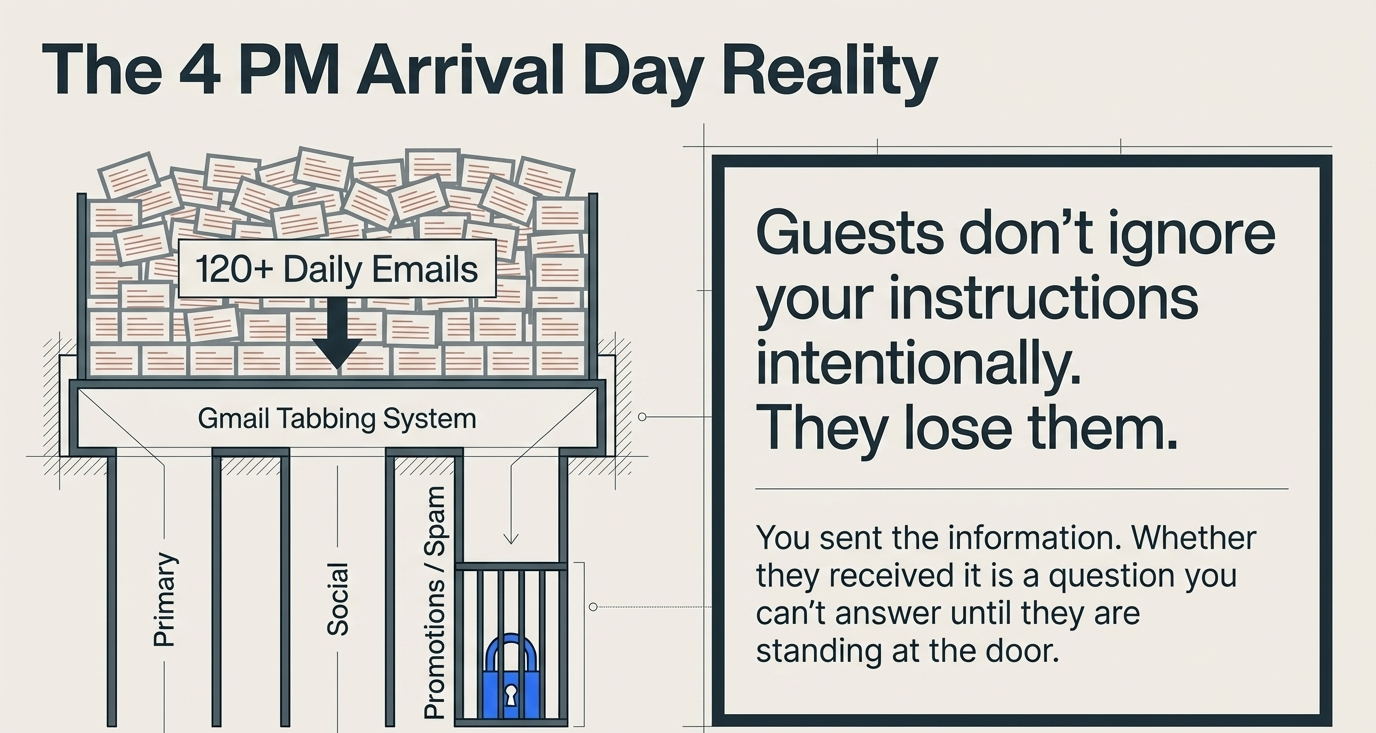 Guests don't ignore your instructions intentionally. They lose them.
Guests don't ignore your emails on purpose. They lose them. Gmail's tabbing system sorts messages into Primary, Promotions, and Social. Your check-in email might land in any of those tabs, or in spam. The guest searches for it at 4 PM on arrival day and can't find it.
Spam filter roulette
Email deliverability is a real problem for individual senders. Unlike platforms like Airbnb that have established sender reputations, your personal or business email has no guaranteed delivery. Spam filters are aggressive and unpredictable. You've sent the information. Whether the guest received it is a different question — and one you often can't answer until they're standing at the door asking for the code you already sent.
No property context
When you manage multiple properties, email threads have no inherent structure. That thread about the wifi password — which property is it for? If you're searching your inbox three months later because of a dispute, you have to mentally reconstruct which conversation was about which property and which stay.
This gets worse as your volume grows. By the time you have a dozen active conversations across two or three properties, your inbox is a flat list of unrelated threads with no hierarchy or organization.
No team visibility
If your co-host, cleaner, or property manager needs to see what you told the guest, they can't. The conversation lives in your inbox. You can forward it, but now there are two copies of the conversation diverging in two different inboxes. If the co-host replies, the guest might get contradictory information.
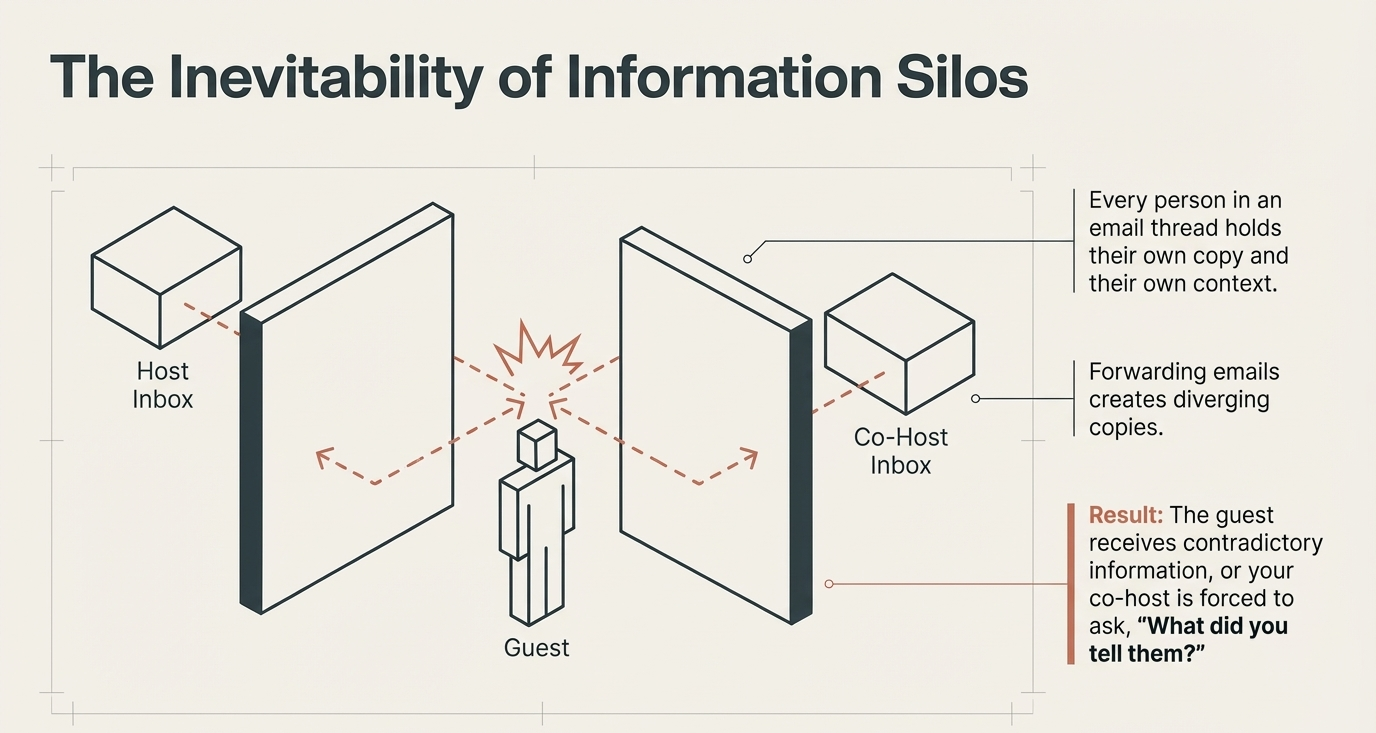 Email creates information silos by design. The result: contradictory information, or your co-host asking 'What did you tell them?'
Email creates information silos by design. Every person in the conversation has their own copy, their own thread state, and their own context. There's no single source of truth.
No audit trail
When a dispute arises — the guest claims they weren't told the rules, or that you agreed to something you didn't — your evidence is an email thread that you have to export, screenshot, or forward to the platform's resolution center. If the relevant message was sent via text instead of email, you're digging through a different app. If it was a phone call, you have no record at all.
What good communication looks like
The hosts who have moved past email-based guest communication share a common set of requirements for whatever system replaced it:
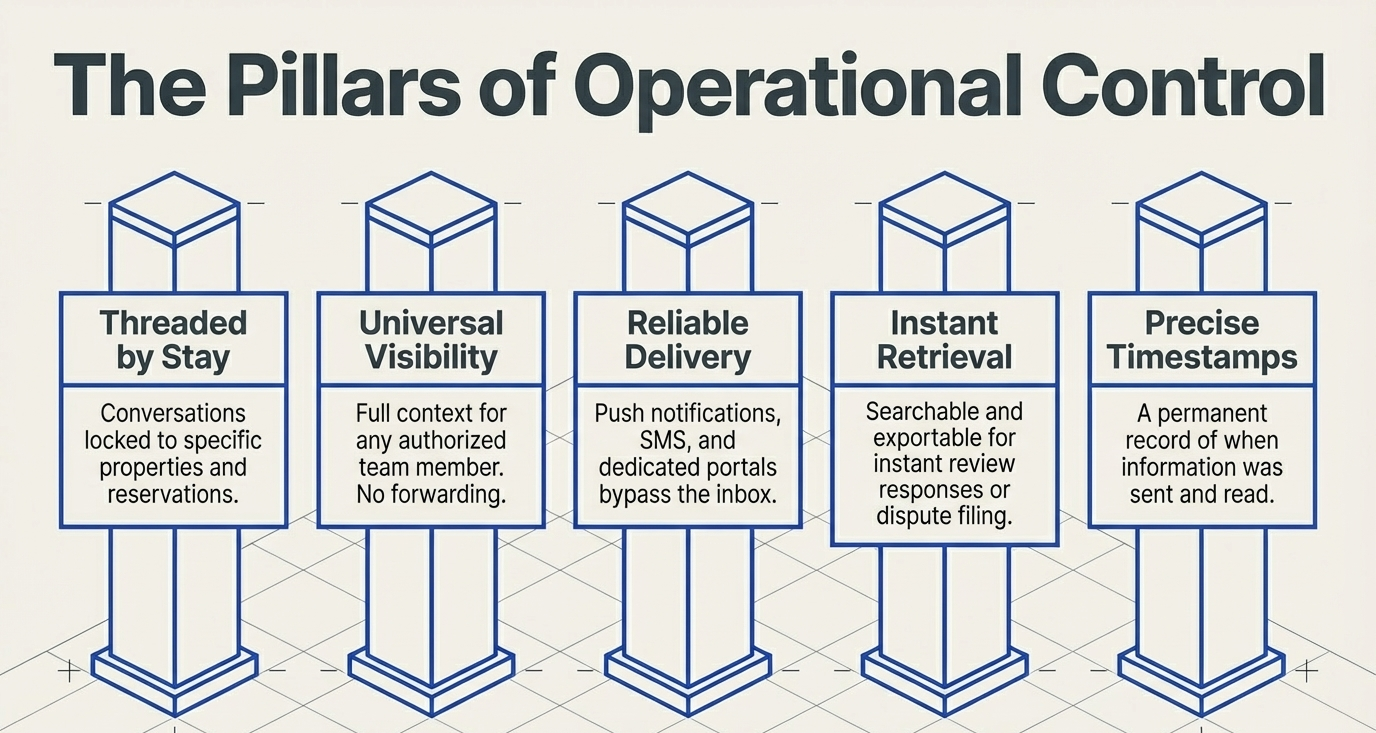 Five pillars that separate operational communication from email chaos.
Threaded by property and stay. Every conversation is tied to a specific property and a specific reservation. When you need to find what you told the guest in Unit B during their March stay, you go to that property, that reservation, and the conversation is right there.
Visible to the team. Anyone on your team with access to that property can see the conversation. If your co-host needs to jump in while you're unavailable, they have full context. No forwarding, no "what did you tell them?" texts.
Notification system that works. Guests get notified through a reliable channel — not competing with 120 other emails. Push notifications, SMS alerts, or a dedicated portal where they know to look.
Searchable and exportable. When you need to reference a past conversation for a review response, a dispute, or just to remind yourself what you told the last guest about trash day, you can find it in seconds.
Timestamped. Every message has a timestamp. Not a "sent approximately Tuesday" timestamp — a precise record of when information was communicated and when it was read.
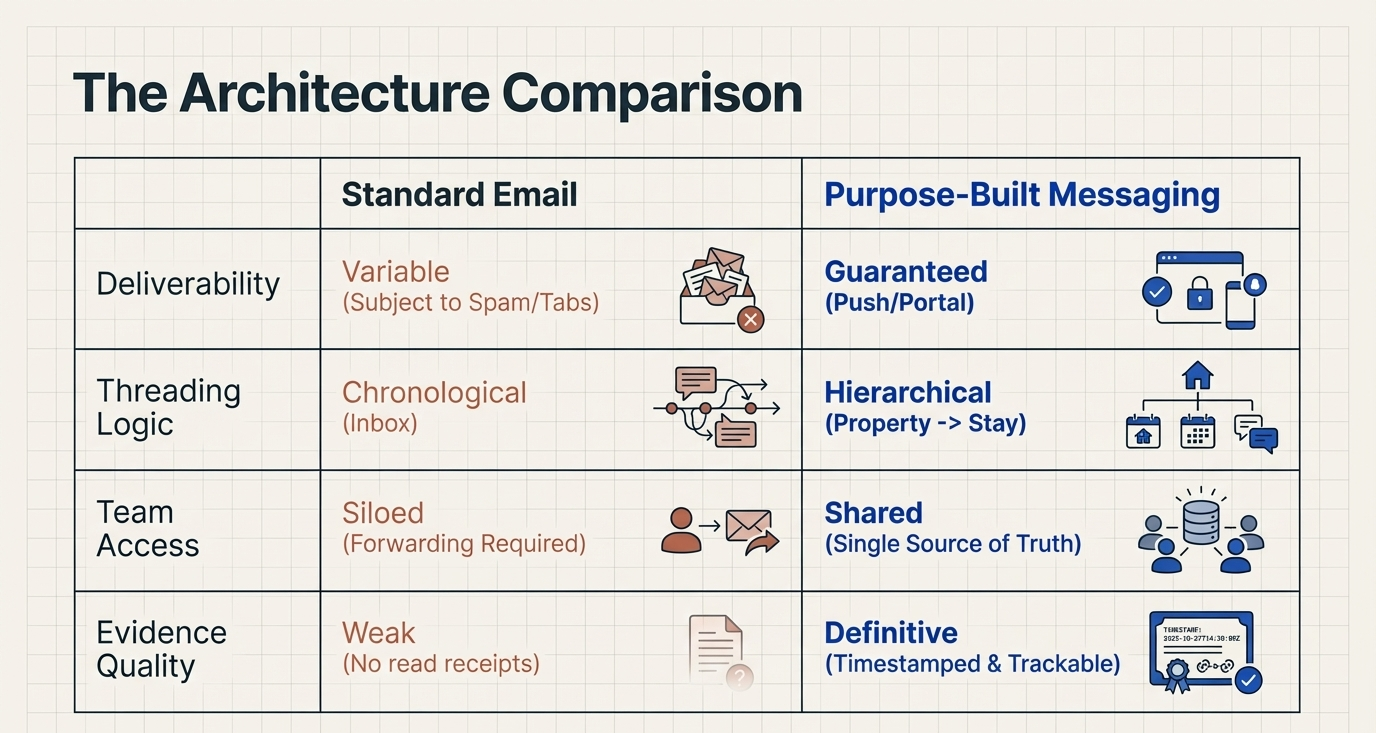 The structural comparison makes the gap clear. Purpose-built messaging wins on every dimension that matters.
The audit trail matters more than you think
Guest communication isn't just about customer service. It's a legal and operational record. When a guest files a damage claim against you, disputes a charge, or leaves a review claiming you didn't provide information, your communication history is your evidence.
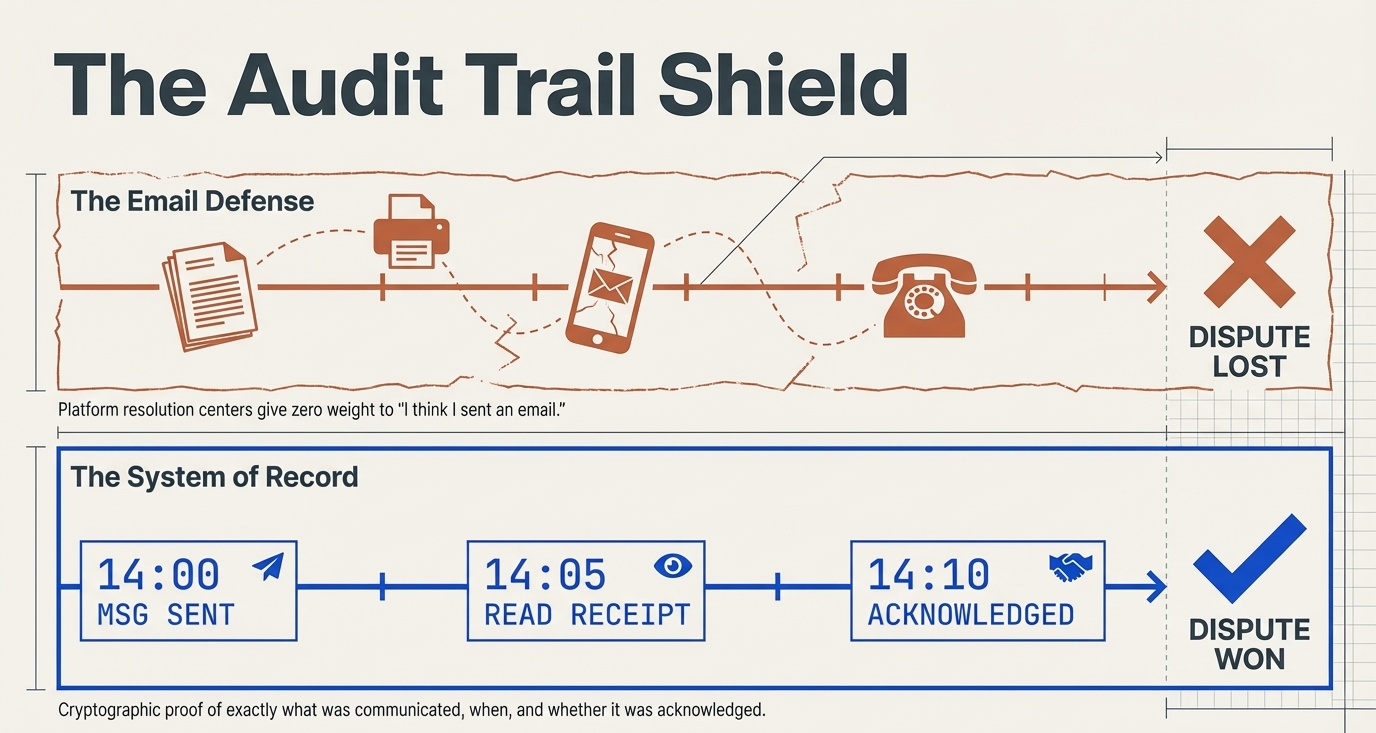 Cryptographic proof of exactly what was communicated, when, and whether it was acknowledged.
Platform resolution centers — Airbnb, VRBO, Booking.com — give more weight to documented, timestamped communication than to "I told them verbally" or "I think I sent an email about that." The hosts who win disputes are the ones who can produce a clear record of what was communicated, when, and whether the guest acknowledged it.
This is where email fails most critically. Even if you did send the email, proving the guest received and read it is nearly impossible. An in-app messaging system with read receipts and acknowledgment tracking gives you that proof.
Moving past email
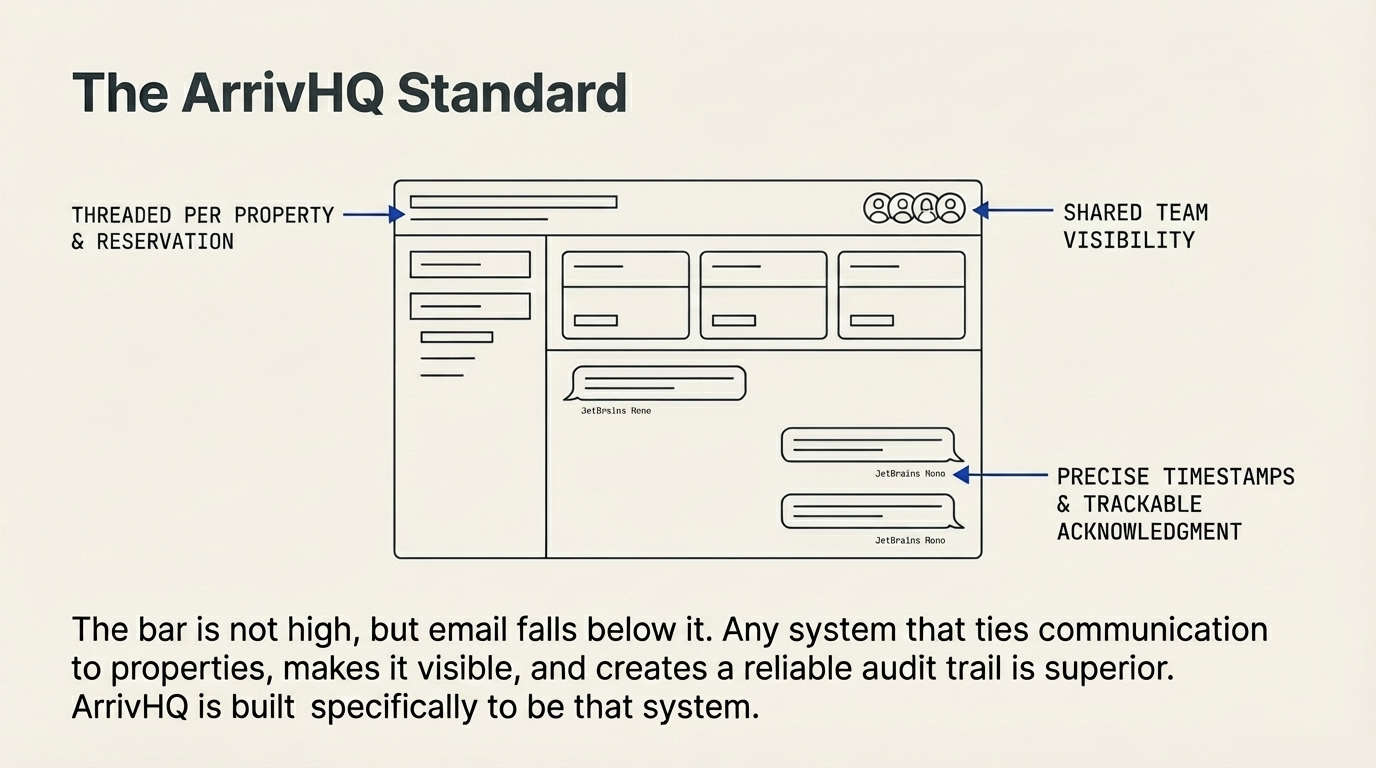 The bar is not high, but email falls below it. Any system that ties communication to properties, makes it visible, and creates a reliable audit trail is superior.
ArrivHQ's messaging system is built specifically for this use case. Conversations are threaded per property and per reservation. Your team sees the same conversation. Guests access their messages through a dedicated portal tied to their stay, not through an email client competing for their attention. Every message is timestamped, and guest acknowledgment is trackable.
But even if you don't use ArrivHQ, the principle holds: any system that ties communication to properties, makes it visible to your team, and creates a reliable audit trail is better than email. The bar is not high. Email just happens to be below it.
The transition
You don't have to stop using email entirely overnight. But you should stop using it as your primary channel for operational guest communication — check-in instructions, house rules, access codes, and anything you might need to reference later.
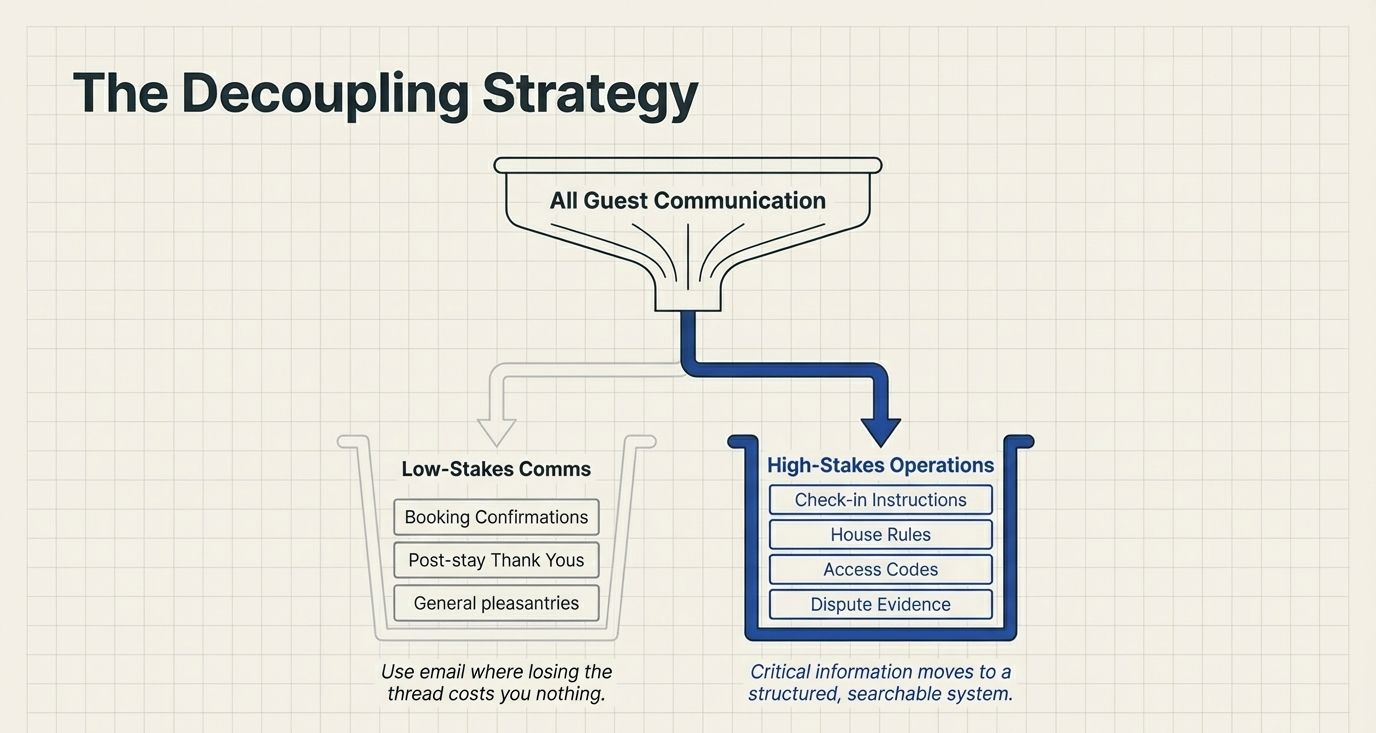 Critical information moves to a structured, searchable system. Use email where losing the thread costs you nothing.
Move the critical stuff into a system that's structured, searchable, and team-visible. Use email for what it's good at: booking confirmations, post-stay thank-you notes, and the kind of low-stakes correspondence where losing the thread doesn't cost you anything.
 Your future self — the one dealing with a damage dispute at 10 PM — will thank you.
Your future self — the one dealing with a damage dispute at 10 PM or trying to remember what you told a guest six months ago — will thank you.