
One property is a side hustle. Two properties is a system problem.
That's not a criticism — it's a description of the inflection point that every growing STR host hits. The habits, workarounds, and mental models that worked for a single property start breaking the moment you add a second. And by the time you're managing three or four, the cracks in your process aren't just inconvenient. They're costing you money, reviews, and sanity.
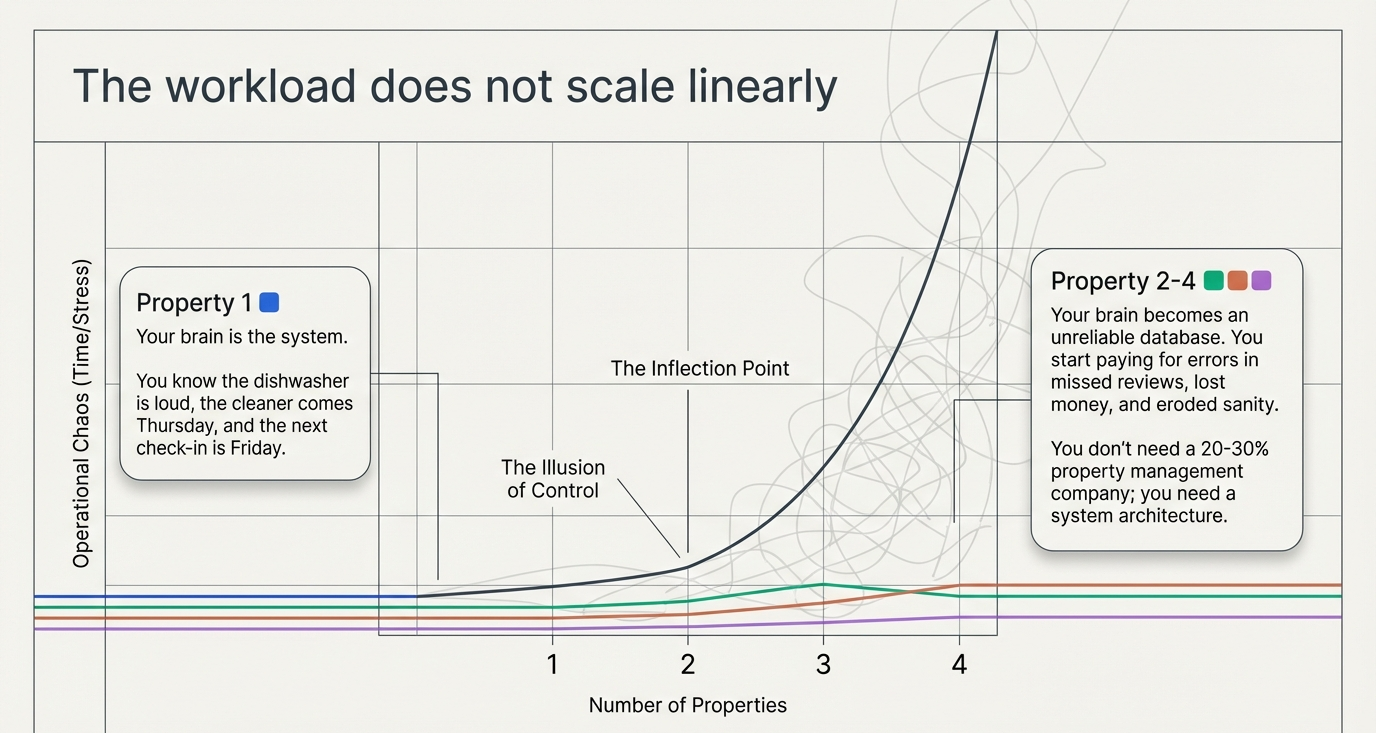 Your brain is the system at one property. By two, you've crossed the inflection point into system architecture territory.
The good news is that this problem is solvable without hiring a property management company that takes 20-30% of your revenue or subscribing to enterprise software designed for a 50-unit portfolio. But solving it requires understanding what actually breaks and building a system before the chaos forces you into one.
What breaks at two properties
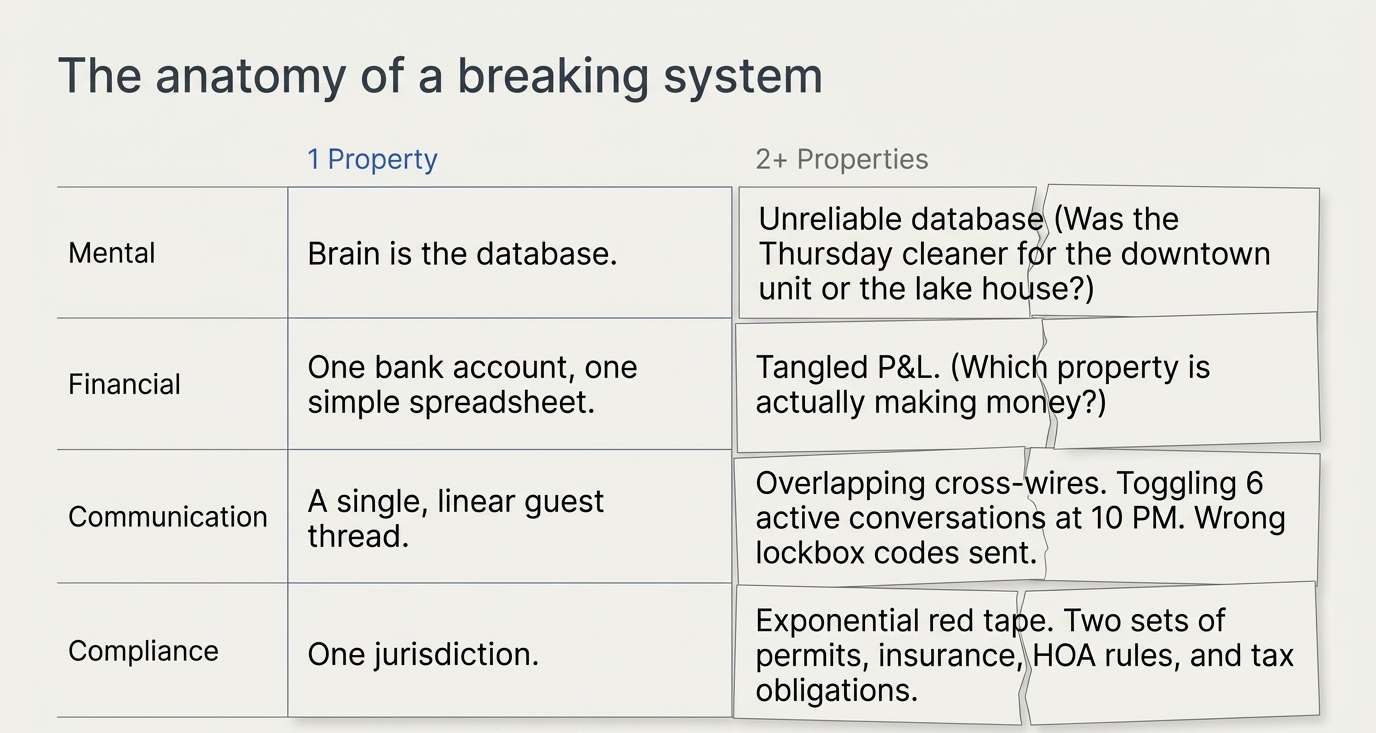 Every system that worked at one property — mental, financial, communication, compliance — breaks differently at two.
Mental tracking fails
With one property, you can keep everything in your head. You know the next check-in is Friday, the cleaner is coming Thursday, the dishwasher has been making a noise, and you need to replace the bath mat. You don't need a system because your brain is the system.
Add a second property and your brain becomes an unreliable database. Was the Thursday cleaner for the downtown unit or the lake house? Which property needs the new bath mat? The dishwasher noise — have you already called the repair service or just thought about calling them?
The errors that emerge aren't dramatic. They're small — a missed supply restock, a double-booked cleaner, a maintenance task that slipped through. But small errors accumulate, and guests experience them as a pattern of disorganization.
Financial tracking gets tangled
One property, one bank account, one set of expenses. You can track profitability in a spreadsheet without too much effort.
Two properties sharing the same bank account, with supplies purchased at the same store on the same trip, with a cleaner who works both units — now you need per-property expense allocation. That $200 Costco run: $120 for Unit A, $80 for Unit B, and the receipt doesn't naturally split that way.
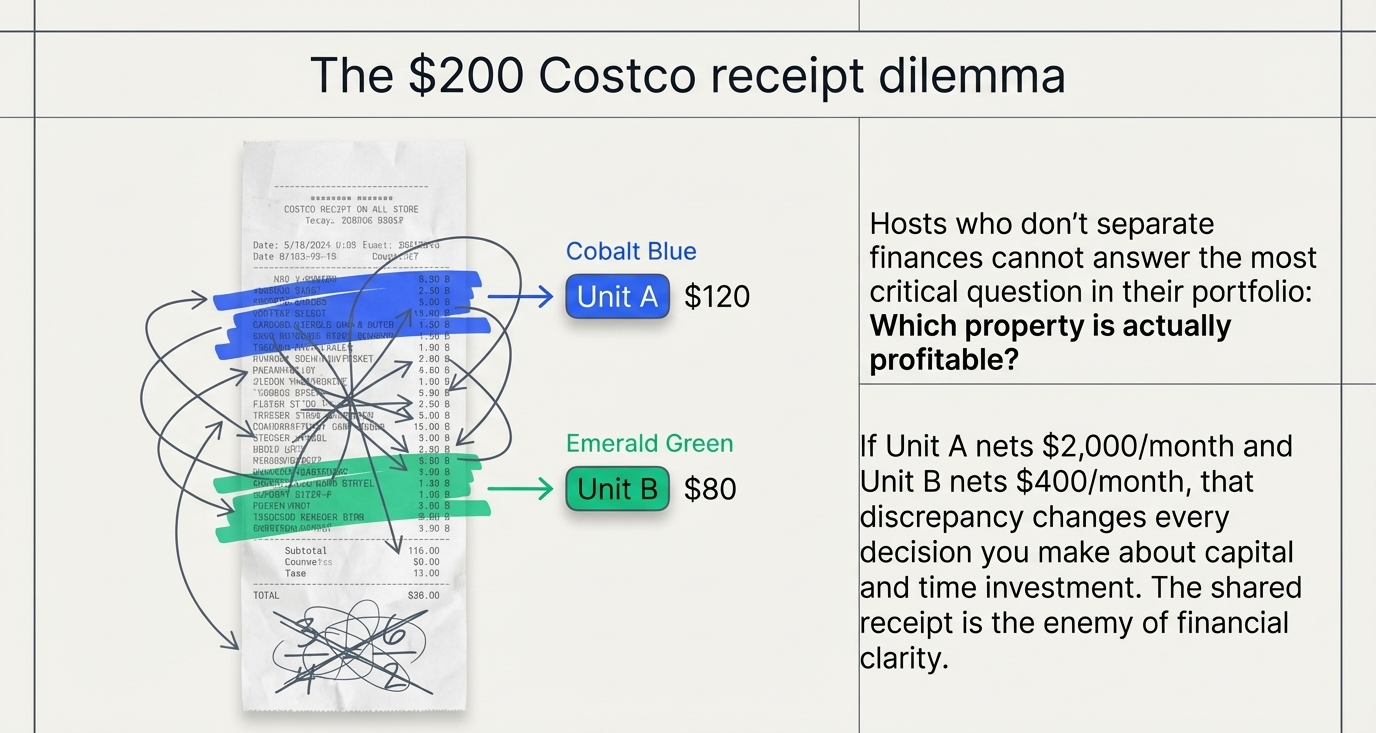 The shared receipt is the enemy of financial clarity. If you can't split it by property, you can't answer the most important question: which unit is making money?
Hosts who don't separate finances by property can't answer the basic question every multi-property owner needs to answer: which property is actually making money? If Unit A nets $2,000/month and Unit B nets $400/month, you need to know that — because it changes every decision you make about where to invest time and capital.
Communication complexity multiplies
With one property, guest communication is a single conversation thread. With three properties and overlapping stays, you might have six active guest conversations at any given time. Each one is about a different property with different details, different access codes, and different quirks.
The wrong lockbox code sent to the wrong guest is no longer a hypothetical — it's a Tuesday. And when you're responding to messages at 10 PM, toggling between conversations about properties in different neighborhoods, the probability of a mistake goes up with every unit you add.
Compliance doubles (at least)
Every property has its own permits, insurance policies, tax obligations, and potentially its own HOA rules. If your first property is in a city that requires an STR license and your second is in a different jurisdiction, you now have two sets of regulations to track, two renewal dates to remember, and two sets of rules about occupancy limits, parking, and noise ordinances.
This is the administrative burden that catches hosts off guard. The second property isn't twice the compliance work — it's often more, because the rules are different.
Per-property everything
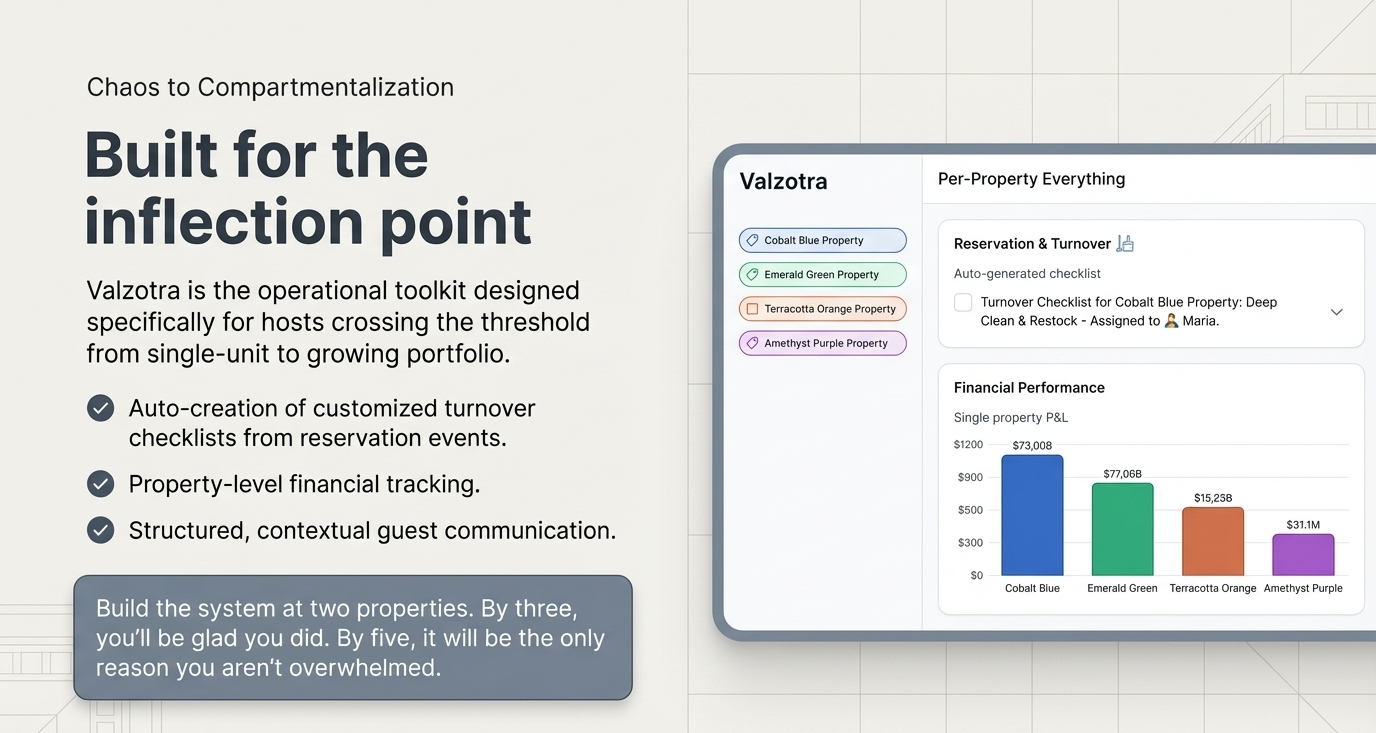
The fundamental principle for managing multiple properties is simple: every piece of data should be tied to a specific property. Not floating in a general inbox, not lumped in a shared spreadsheet, not living in your head with a mental tag of "that's for the lake house."
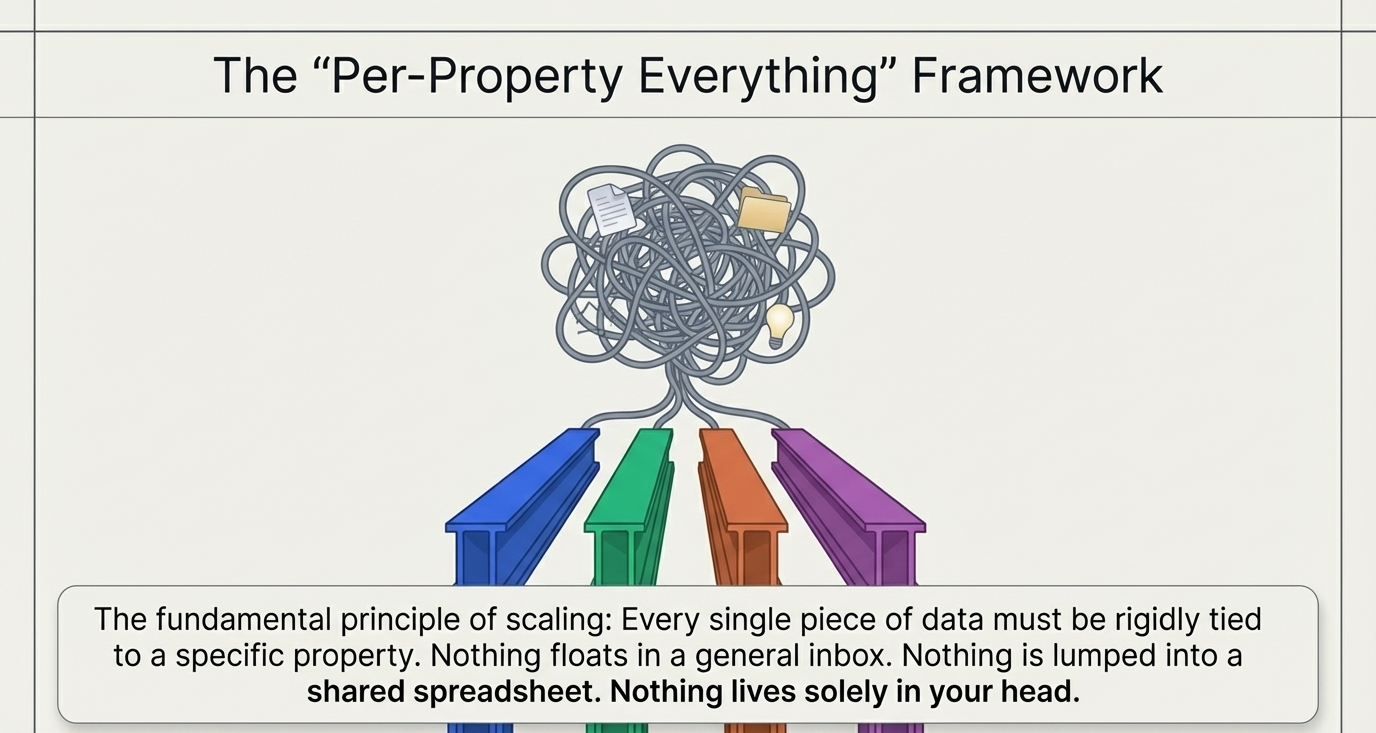 The fundamental principle of scaling: every single piece of data must be rigidly tied to a specific property.
Per-property expenses and revenue
Every expense should be categorized by property at the time of purchase, not reconciled later. Every revenue payment should be assigned to the property that generated it. This gives you a real-time P&L per unit and lets you make informed decisions about pricing, investment, and whether a particular property is worth keeping.
Per-property team assignments
Your cleaner for Unit A doesn't need to see Unit B's schedule. Your handyman who covers the downtown properties doesn't need notifications about the suburban ones. Assigning team members to specific properties keeps their view focused and your communication targeted.
Per-property checklists
A turnover checklist for a studio apartment and a turnover checklist for a three-bedroom house are not the same. Templates by property type let you standardize the process while accounting for the differences in layout, amenities, and guest expectations.
Per-property guest communication
Every guest conversation should be visibly connected to the property and reservation it belongs to. When you're reviewing a message thread, you should see the property name, the guest's dates, and the full history without having to reconstruct context from memory.
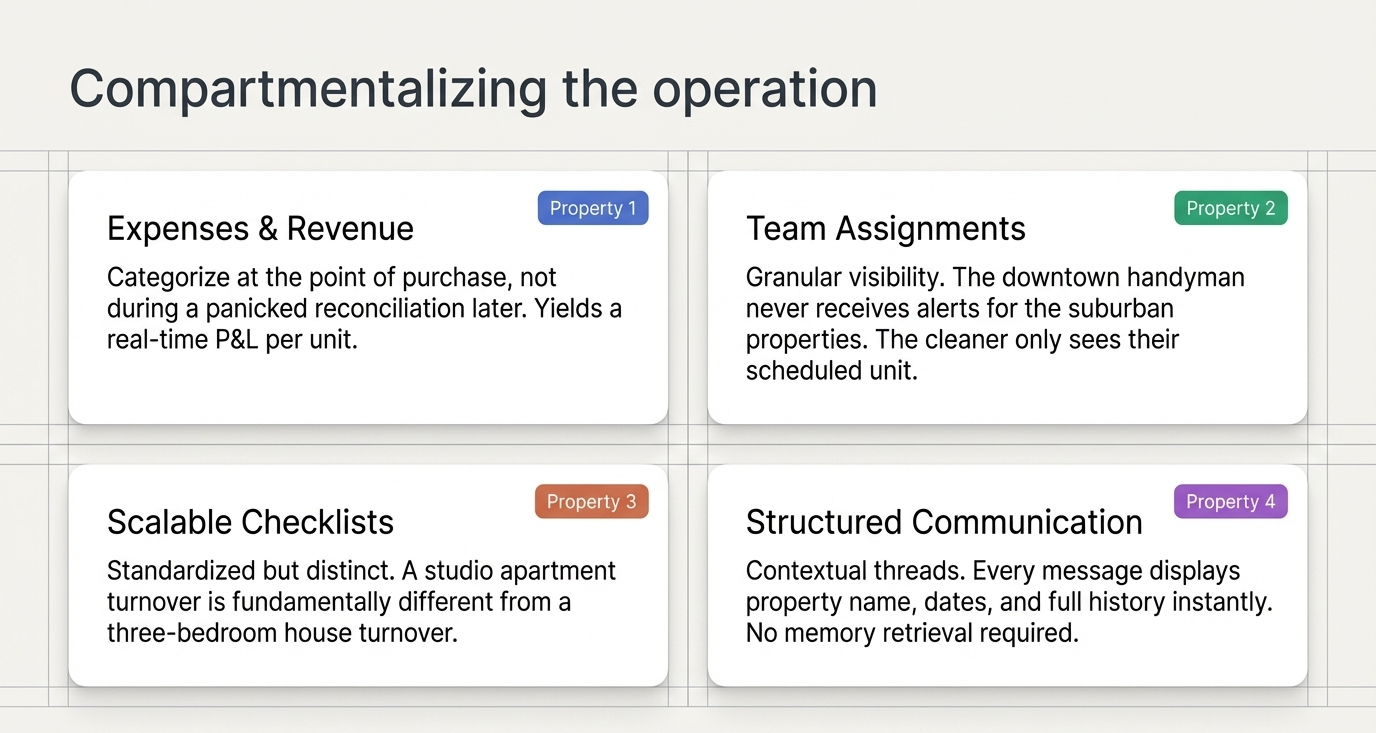 Compartmentalize everything — expenses, team assignments, checklists, and communication — by property.
Checklist templates that scale
One of the most effective tools for multi-property management is a reusable checklist template. Instead of writing out turnover tasks from scratch for every cleaning, you create a template once and deploy it for every turnover at that property.
The template covers everything: cleaning tasks by room, supply restocking, linen replacement, lockbox code updates, and any property-specific items (empty the dehumidifier, check the sump pump, water the plants).
When a reservation ends, a new checklist is created from the template and assigned to the right team member. The cleaner works through it. You see the progress. When it's done, the property is confirmed ready.
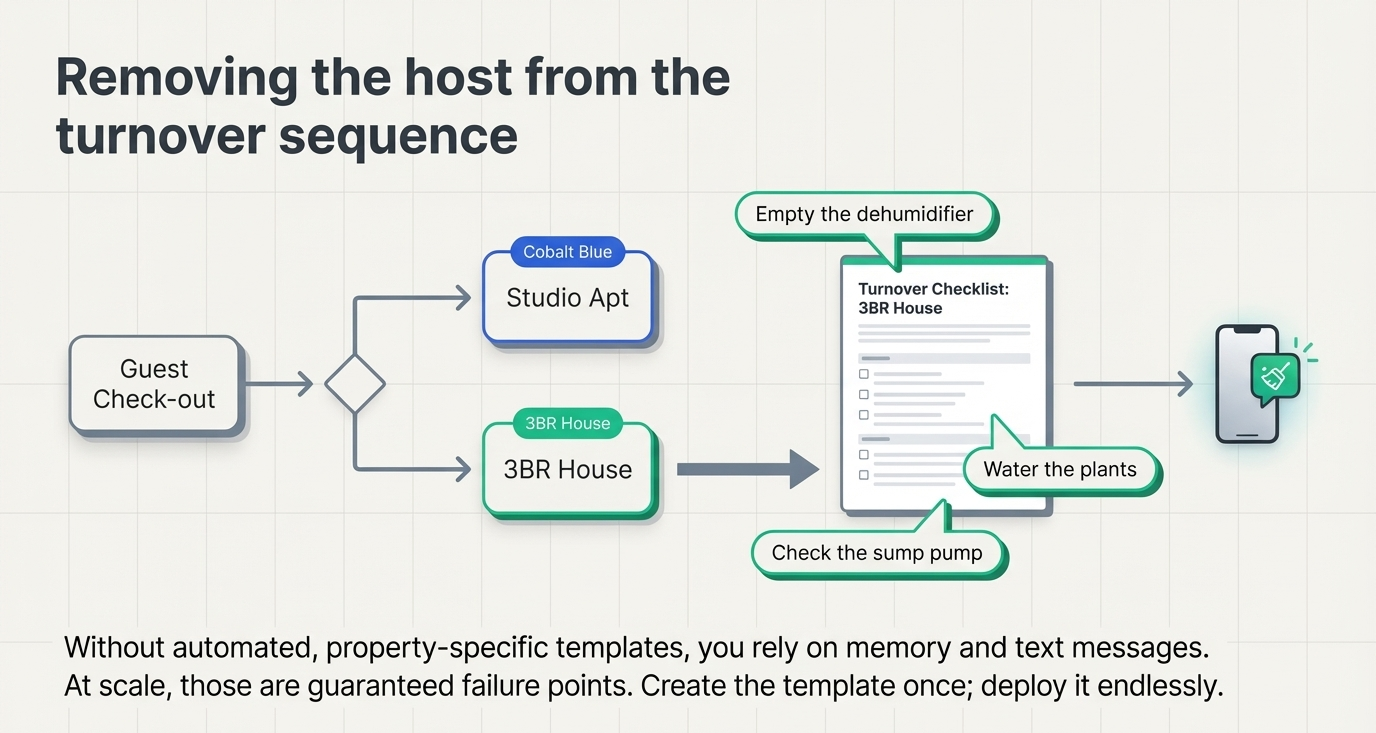 Create the template once, deploy it endlessly. Without automation, you rely on memory and text messages — guaranteed failure points at scale.
This approach works for one property. It becomes essential at two or three. Without it, you're relying on memory and text messages — and at scale, those aren't reliable.
ArrivHQ supports checklist templates with per-property customization and auto-creation from reservation events. When a guest checks out, the turnover checklist generates automatically and assigns to the right cleaner. No manual creation, no risk of forgetting.
When you actually need a PMS
There's a real threshold where a full property management system becomes the right tool. For most hosts, that's somewhere around five properties or when you're managing across multiple booking platforms and need automated channel synchronization.
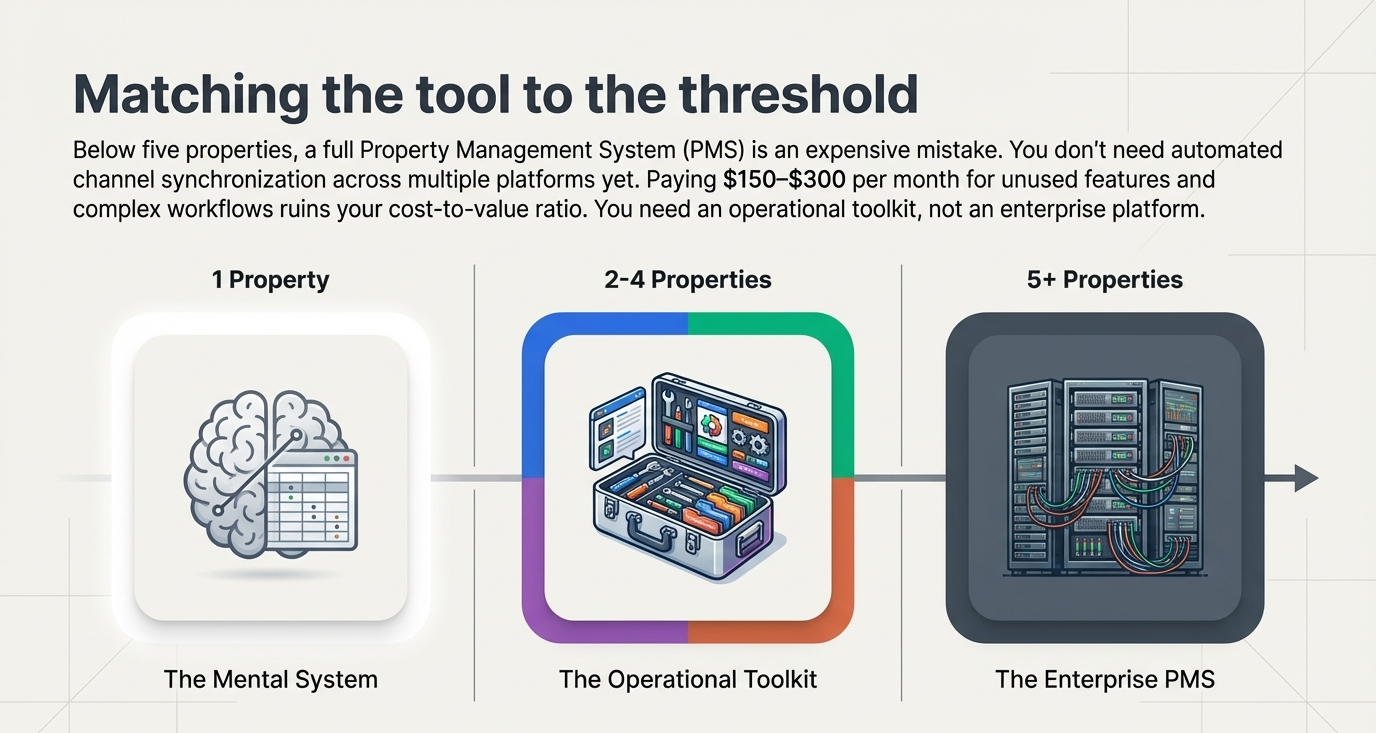 Below five properties, a full PMS is an expensive mistake. You need an operational toolkit, not an enterprise platform.
Below that threshold, the cost-to-value ratio of a full PMS doesn't make sense. You're paying $150-$300 per month for features you don't use, learning a complex platform that's designed for a different scale of operation, and potentially locking yourself into a workflow that doesn't match how you actually work.
What you need at two to four properties is simpler: per-property financial tracking, team coordination with property-level assignments, checklist-based turnover management, and structured guest communication. That's an operational toolkit, not an enterprise platform.
The mindset shift
The hosts who successfully manage multiple properties share a common trait: they stopped thinking of each property as a separate project and started thinking of their portfolio as a single operation with per-property data.
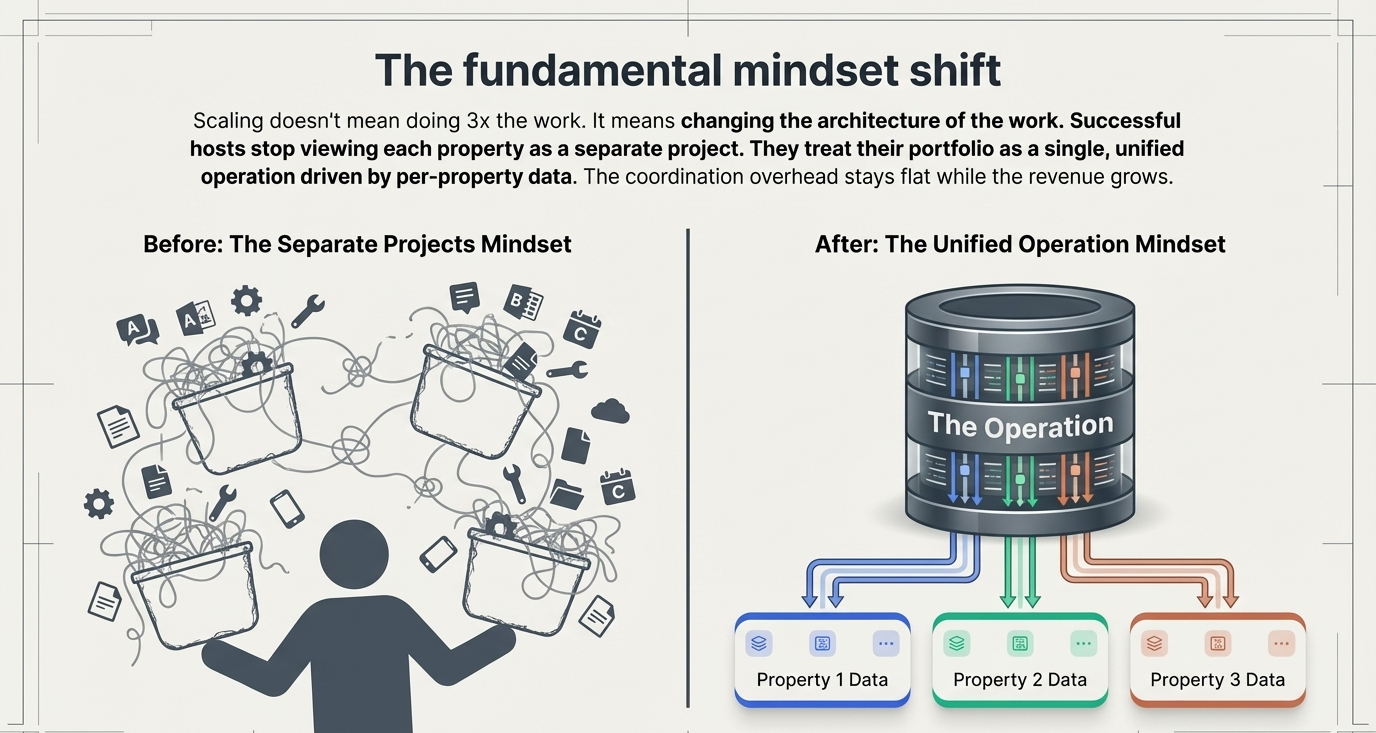 Scaling doesn't mean doing 3x the work. It means changing the architecture of the work.
The difference is subtle but important. A "separate projects" mindset leads to duplicate tools, inconsistent processes, and information scattered across different apps and notebooks. An "operation with per-property data" mindset leads to a single system where every property, team member, expense, and guest conversation lives in one place, organized by property.
That's the system that scales from two properties to five without proportionally increasing your workload. Not because the work disappears — it doesn't — but because the coordination overhead stays manageable instead of growing exponentially.
Start building the system at two properties. By three, you'll be glad you did. By five, it'll be the only reason you're not overwhelmed.
 Build the system at two properties. By three, you'll be glad you did. By five, it'll be the only reason you aren't overwhelmed.