
You started with one property. You cleaned it yourself between guests, restocked the toiletries, took out the trash, and handled turnover in two hours. It worked because it was just you and one calendar to watch.
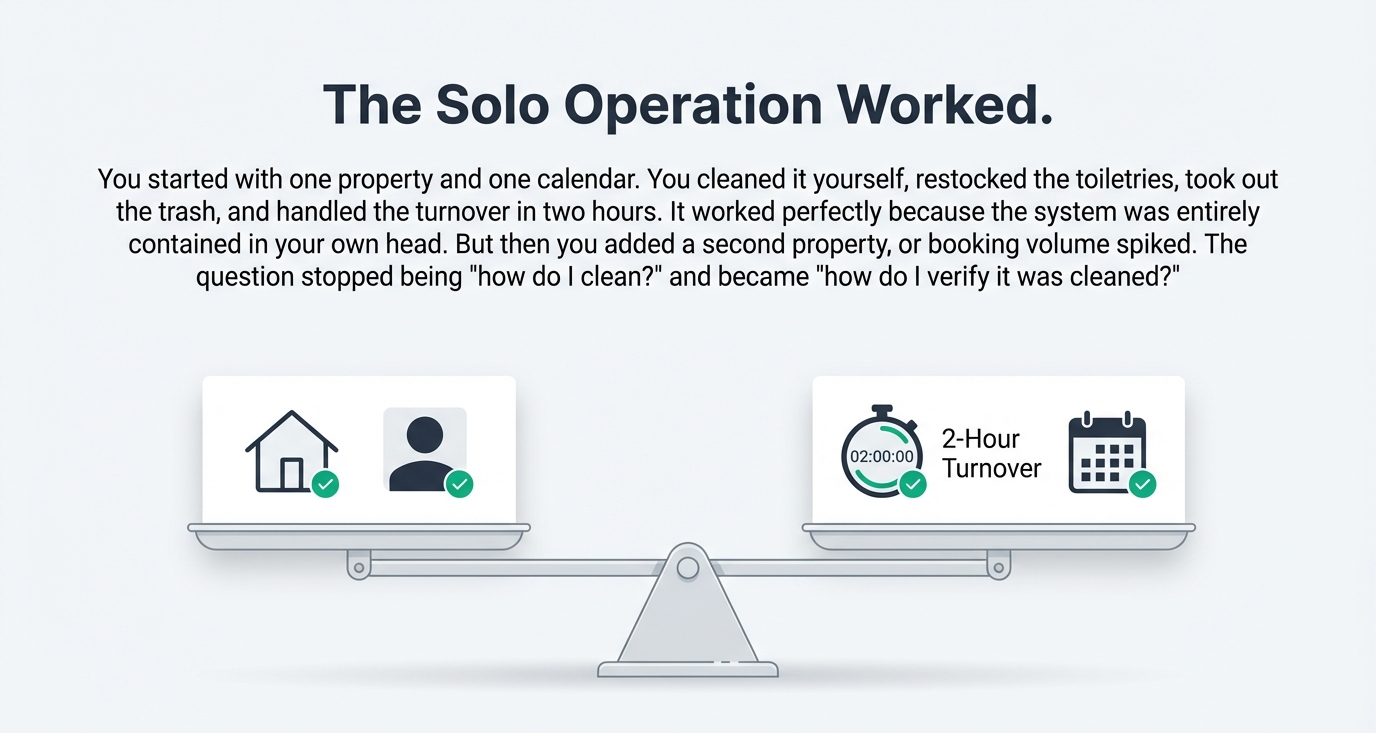 The question stopped being "how do I clean?" and became "how do I verify it was cleaned?"
Then you added a second property. Or your booking volume picked up to the point where you physically couldn't be at the property for every turnover. So you hired a cleaner. Maybe two. And suddenly the question wasn't "how do I clean the property" but "how do I make sure the right person cleans the right property at the right time, every time."
This is where most hosts start Googling property management software. And then they see the price.
The PMS pricing problem
Full property management systems — Guesty, Hostaway, Lodgify — are built for hosts and property managers running 10, 20, 50+ units. Their pricing reflects that. You're looking at $100-$300 per month minimum, often with per-property fees on top, for a platform where you'll use maybe 20% of the features.
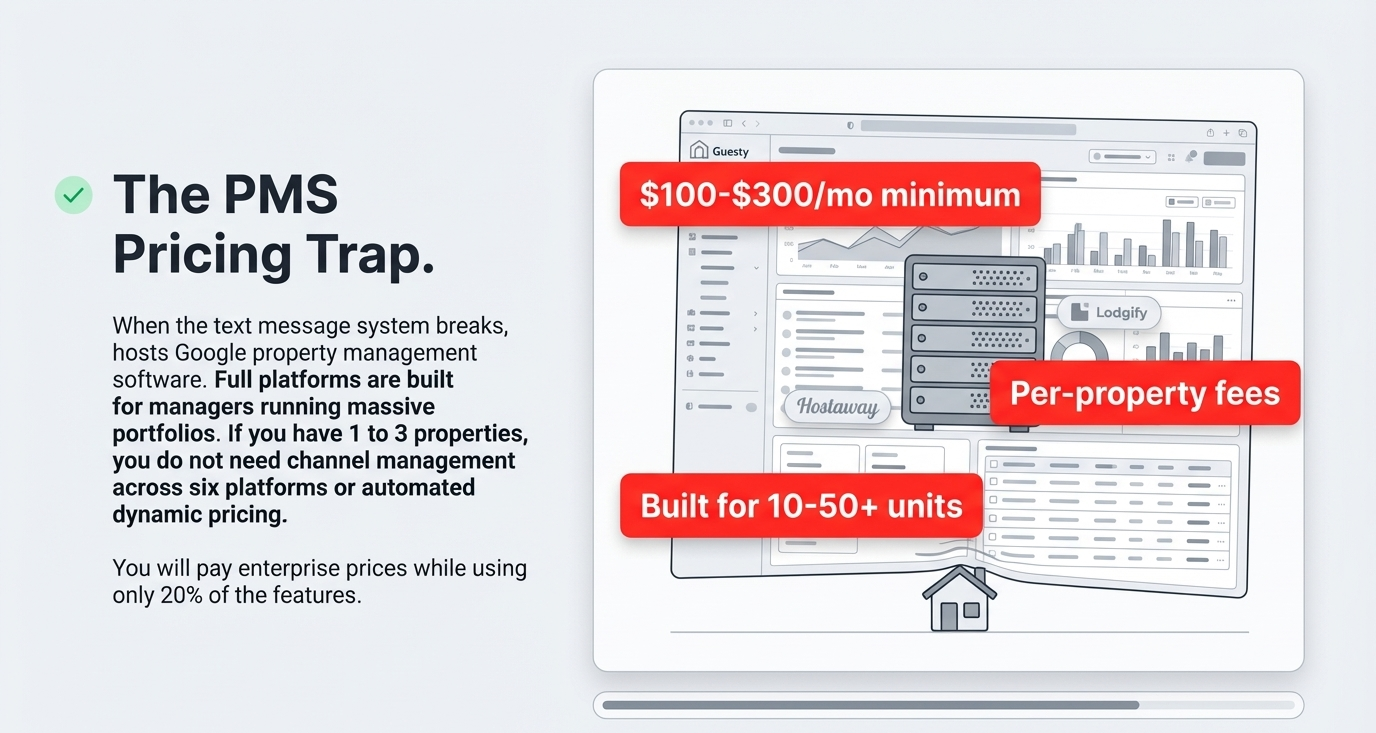 Full platforms are built for managers running massive portfolios. If you have 1 to 3 properties, you do not need channel management across six platforms or automated dynamic pricing.
If you have one to three properties and a small team of cleaners and a handyman, you don't need channel management across six platforms. You don't need automated dynamic pricing across a portfolio. You don't need a built-in owner reporting dashboard.
What you need is a reliable way to tell Maria that Unit B needs to be turned over by 3 PM on Saturday and confirm that it happened.
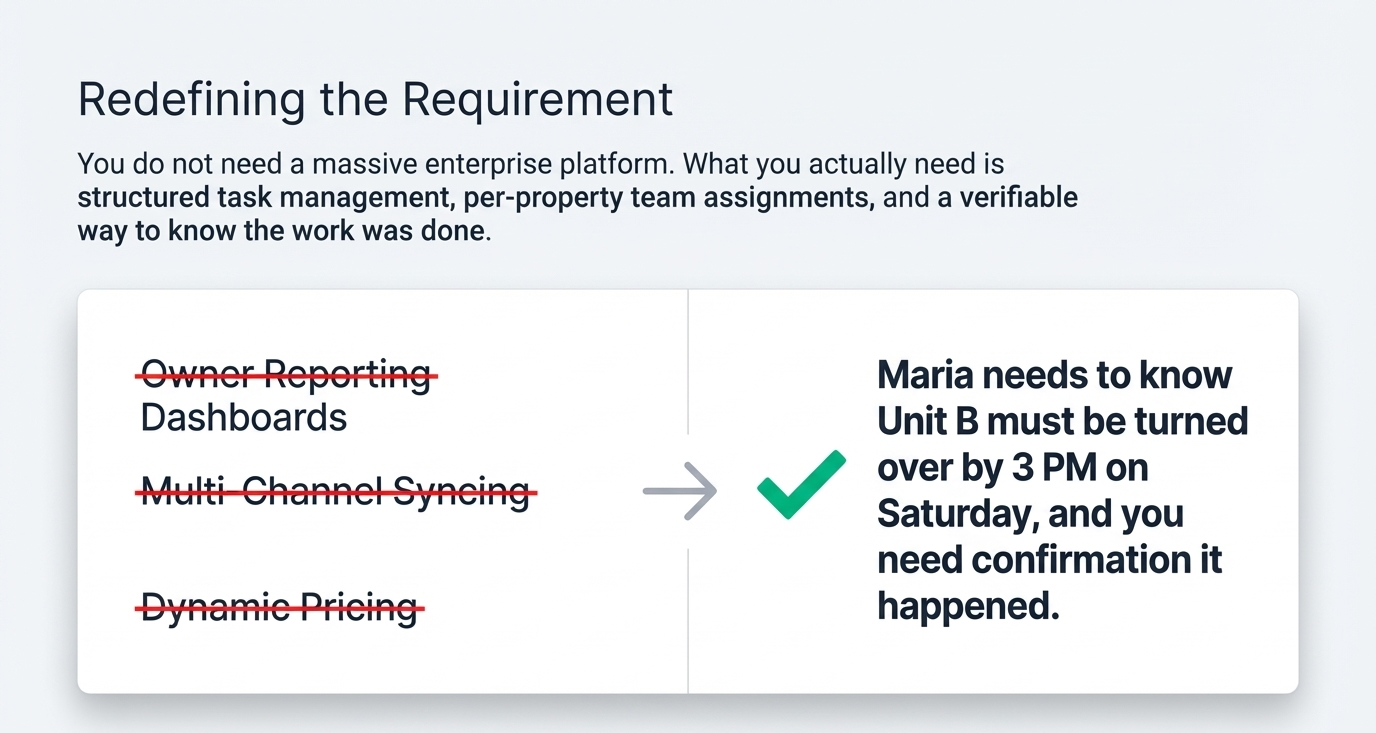 You do not need a massive enterprise platform. You need structured task management, per-property team assignments, and a verifiable way to know the work was done.
The gap between "I need team coordination" and "I need a full PMS" is enormous, and most hosts fall into it.
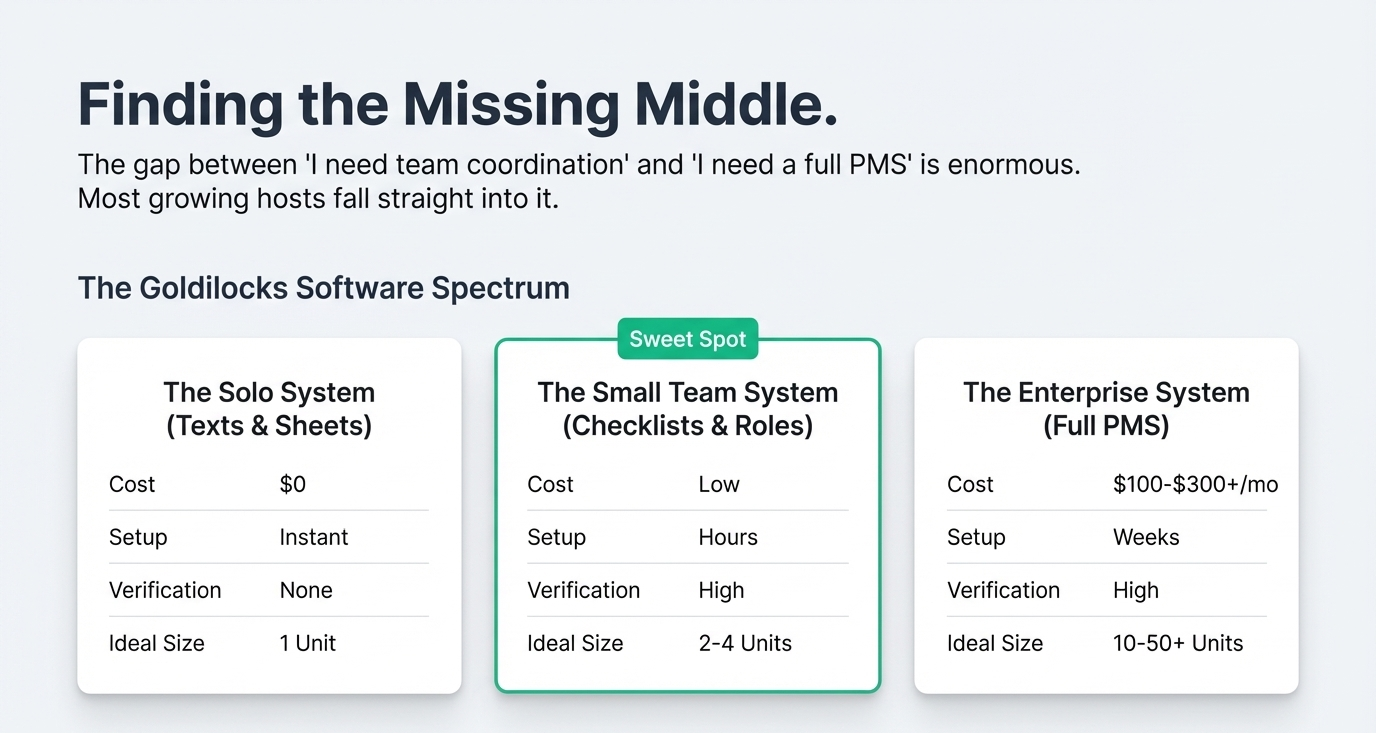 The gap between "I need team coordination" and "I need a full PMS" is enormous. Most growing hosts fall straight into it.
What actually breaks when you add people
The transition from solo host to team-based operation breaks in predictable ways:
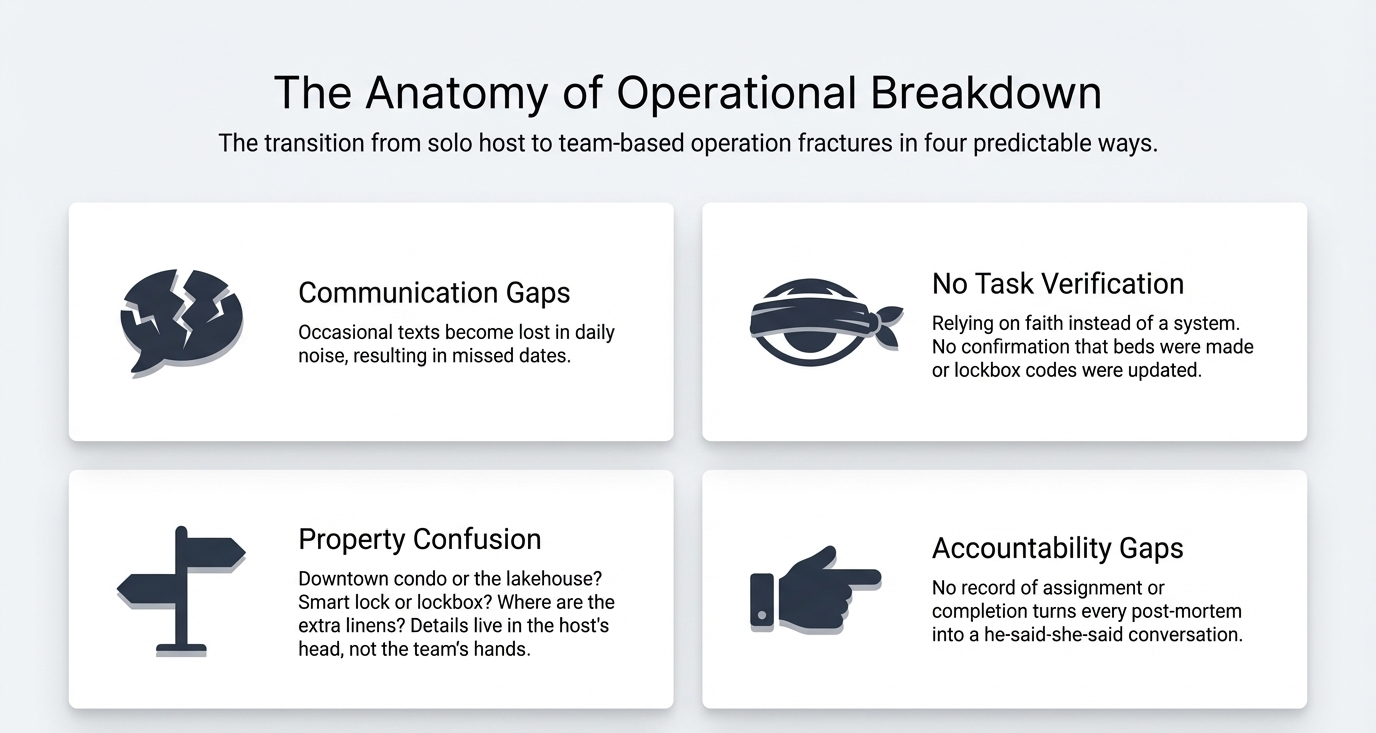 The transition from solo host to team-based operation fractures in four predictable ways.
Communication gaps
You text your cleaner about Saturday's turnover. She responds Tuesday confirming she got it. Saturday comes and she forgot, or confused it with a different property, or thought you meant next Saturday. The guest arrives to an uncleaned unit.
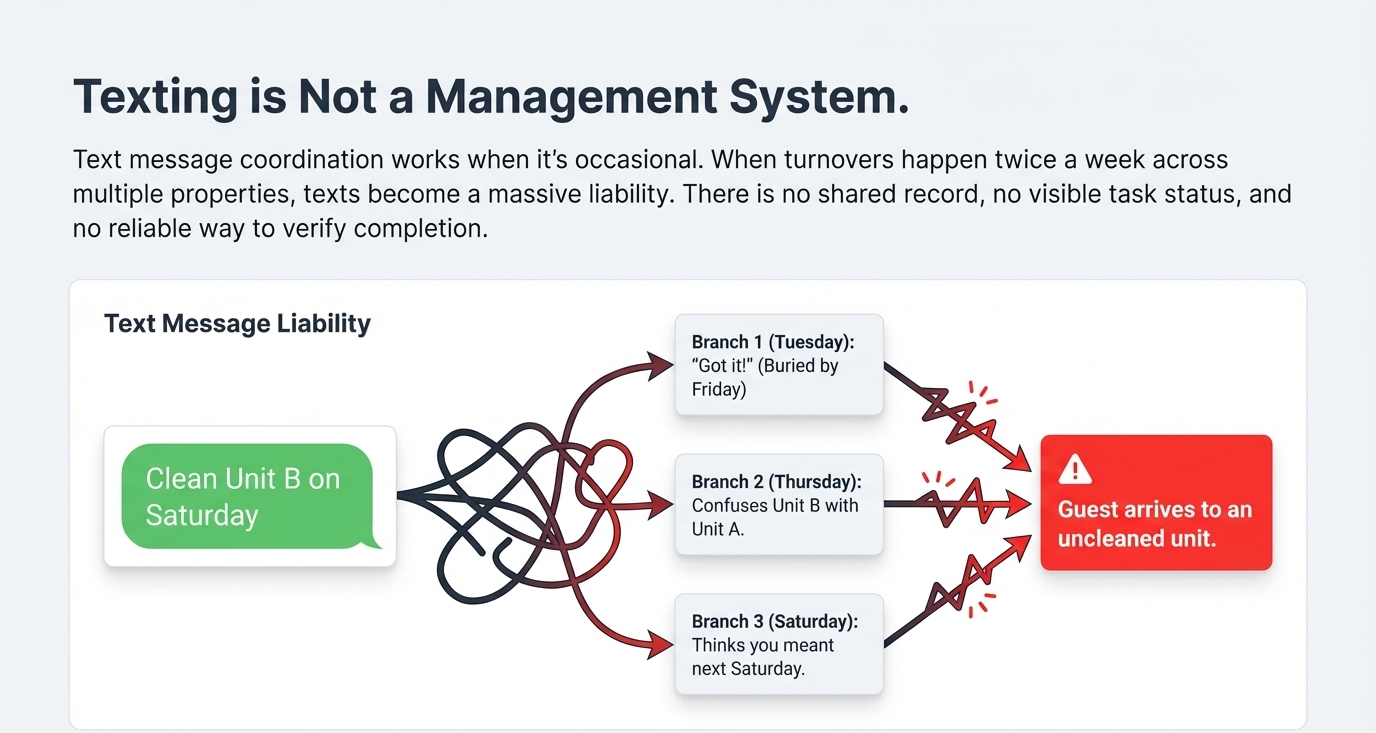 Text message coordination works when it's occasional. When turnovers happen twice a week across multiple properties, texts become a liability.
Text message coordination works when it's occasional. When turnovers are happening twice a week across two properties, texts become a liability. There's no shared record, no task status, and no way for anyone else to see what's been communicated.
No task verification
How do you know the cleaning was done correctly? You trust your cleaner — but trust isn't a system. Without a structured way to confirm that specific tasks were completed (beds made, bathrooms sanitized, supplies restocked, lockbox code updated), you're relying on faith until a guest complains.
Property confusion
When you have multiple properties, team members need to know not just what to do but where. Is this the downtown condo or the lakehouse? Does this property use the lockbox or the smart lock? Where are the extra linens stored?
These property-specific details live in the host's head until they're written down somewhere the team can actually access them.
Accountability gaps
When something goes wrong — the property wasn't cleaned, the wrong supplies were stocked, the guest found dirty dishes — you need to know what happened. Was the task assigned? Was it acknowledged? Was it completed? Without a record, every post-mortem is a he-said-she-said conversation.
The checklist approach
The solution that works for small teams isn't a full PMS. It's checklist templates with team assignments.
Here's how it works in practice:
Step 1: Create a turnover checklist template. List every task that needs to happen during a turnover, in order. Kitchen: dishes washed, counters wiped, fridge emptied and cleaned, supplies restocked. Bathroom: toilet cleaned, shower scrubbed, towels replaced, toiletries restocked. Bedrooms: linens changed, surfaces dusted, floors vacuumed. Common areas: furniture straightened, floors mopped, trash removed. Exterior: porch swept, welcome mat clean, lockbox code updated.
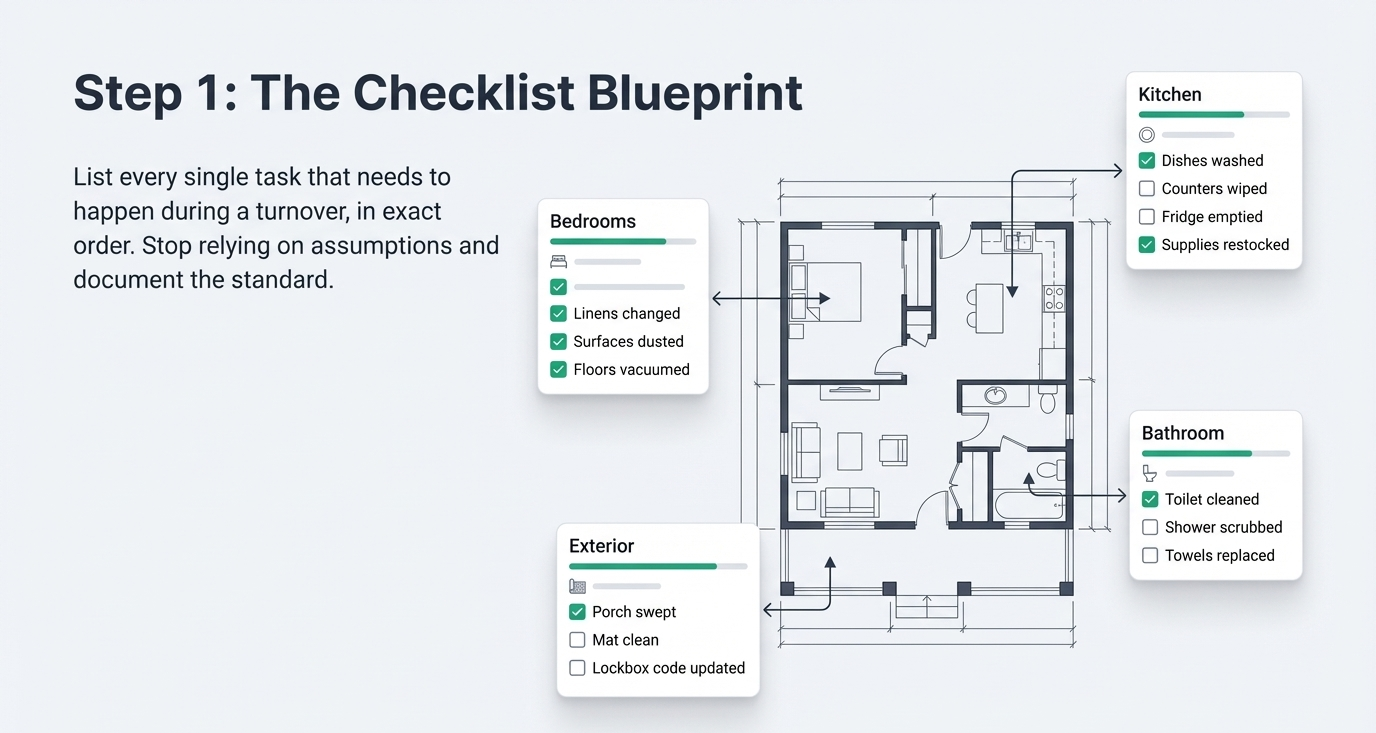 List every single task that needs to happen during a turnover, in exact order. Stop relying on assumptions and document the standard.
Step 2: Assign team members to properties. Maria handles Unit A. Carlos handles Unit B. Both handle Unit C depending on availability. Each person knows which properties are theirs and what's expected.
Step 3: Create a checklist run for each turnover. When a reservation ends, a checklist is created from the template and assigned to the right person. They work through it, marking items complete. You can see the status without sending a text.
Step 4: Review and close. When the checklist is complete, you review it. If something was missed, it's visible. If everything checks out, the property is confirmed ready for the next guest.
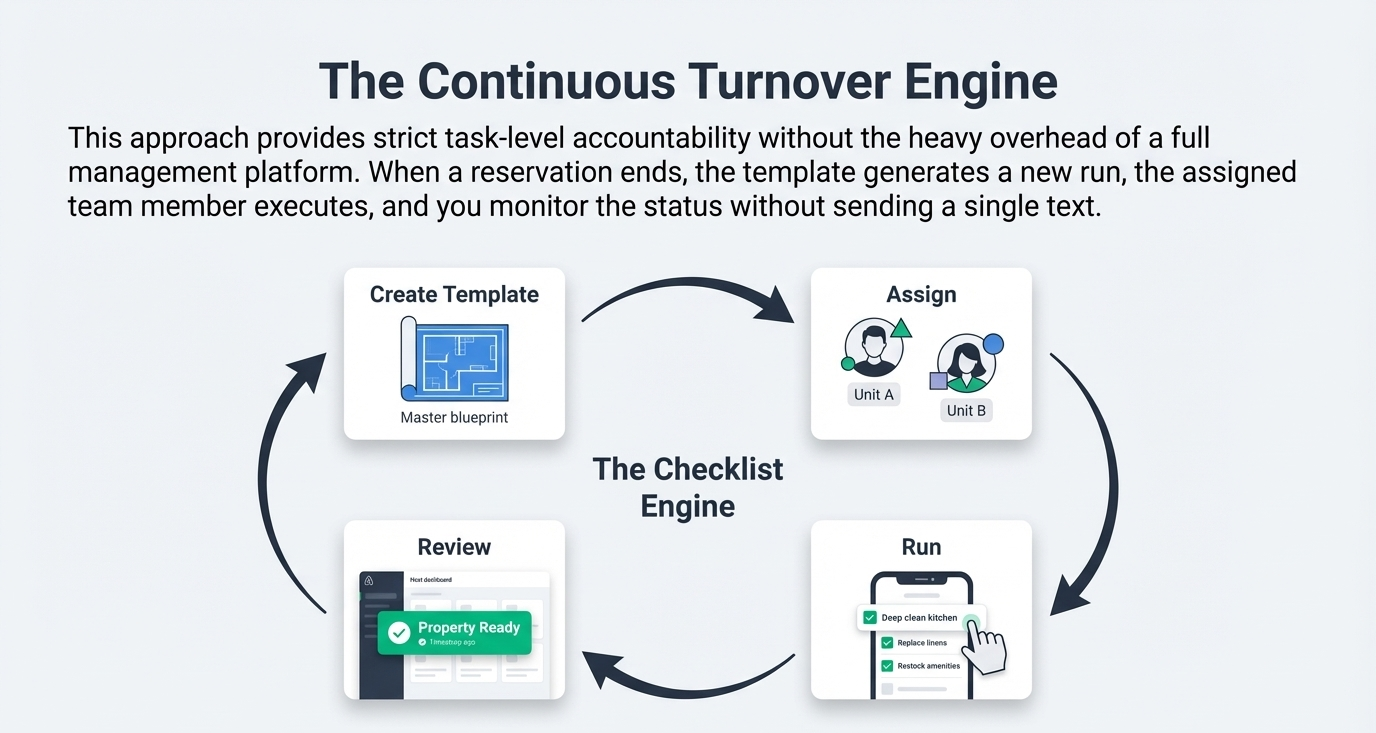 This approach provides strict task-level accountability without the heavy overhead of a full management platform.
This approach gives you task-level accountability without the overhead of a full management platform.
Per-property team roles
Not everyone on your team needs access to everything. Your cleaner for Property A doesn't need to see Property B's financials. Your handyman doesn't need to see guest messages.
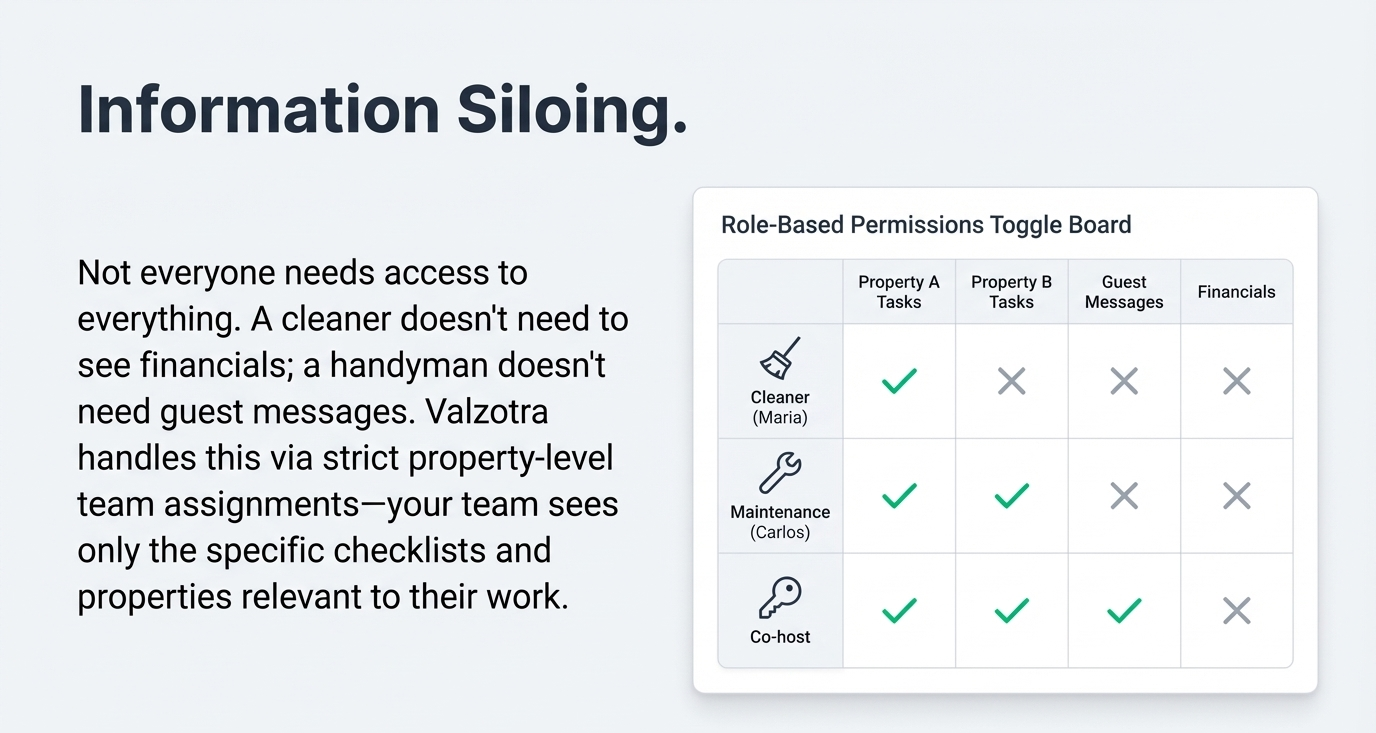 Not everyone needs access to everything. A cleaner doesn't need to see financials; a handyman doesn't need guest messages.
Assigning per-property roles keeps things clean:
- Cleaners get access to their assigned properties' checklists and turnover schedules.
- Maintenance staff get access to work orders and property details for the units they service.
- Co-hosts might get broader access to help with guest communication and booking management.
ArrivHQ handles this with property-level team assignments. You invite team members, assign them to specific properties with specific roles, and they see only what's relevant to their work. Cleaners get their checklists. Managers get the full picture. Nobody's overwhelmed with information they don't need.
Making it stick with your team
The best system is useless if your team won't use it. A few things that help adoption:
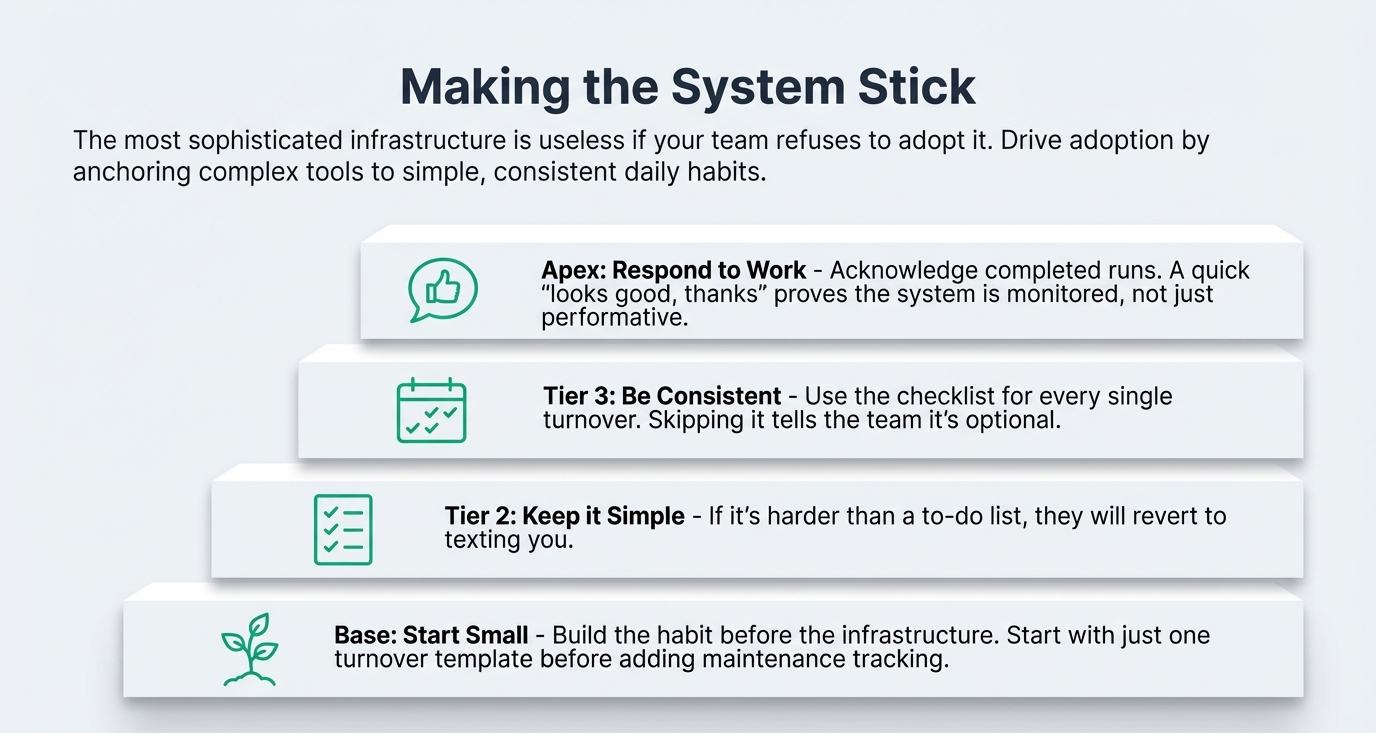 Drive adoption by anchoring complex tools to simple, consistent daily habits.
Keep it simple. If your cleaner has to learn a complex platform to check off that she cleaned the bathroom, she's going to text you instead. The system needs to be as easy as a to-do list.
Be consistent. Use the checklist for every turnover, not just the ones you remember. If you skip it half the time, your team will stop taking it seriously.
Respond to completed checklists. When someone finishes their tasks, acknowledge it. A quick "looks good, thanks" reinforces the habit. Ignoring completed work tells your team that the system is performative.
Start with one template. Don't try to systematize everything on day one. Start with your turnover checklist. Get that working. Then add maintenance request tracking. Then add pre-arrival prep. Build the habit before you build the infrastructure.
You don't need a PMS — yet
There's a point where a full property management system makes sense. When you're managing five or more properties, coordinating across multiple booking platforms, and running a team of ten, the investment pays for itself.
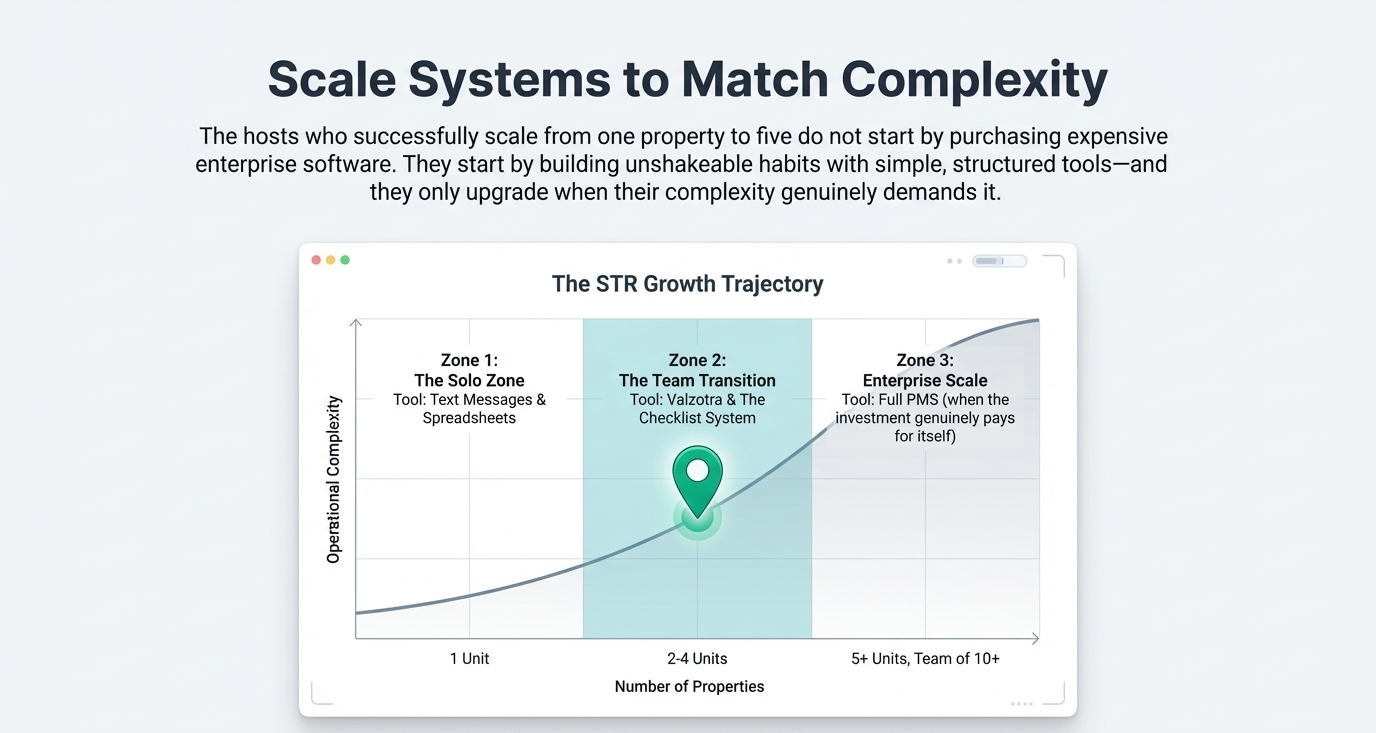 The hosts who successfully scale from one property to five start by building unshakeable habits with simple, structured tools — and only upgrade when their complexity genuinely demands it.
But for the host with one to three properties and a small cleaning team, a PMS is overkill. What you need is structured task management, team assignments by property, and a way to verify that work was done. That's a checklist system, not an enterprise platform.
The hosts who scale successfully from one property to five don't start with expensive software. They start with good habits and simple tools, and they upgrade when the complexity genuinely demands it.